 Ask Jenna
7 Subtle Signs of Emotional Unavailability in Text: Stop the Guesswork

Digital distance isn't just a sign of a busy schedule. It's often a strategic choice to keep you at arm's length. You spend hours dissecting a single "k" or a five-hour silence. You feel like you're asking for too much just by wanting a real conversation. It's exhausting. You aren't crazy for noticing the shift. You're just seeing the first signs of emotional unavailability in text before they become a full-blown heartbreak.
You deserve to stop the guesswork right now. We know the frustration of "breadcrumbing" and the anxiety of being ignored. Recent data shows that 31% of people find texting to be a daily source of anxiety. You don't have to be one of them. This guide will teach you how to identify the specific texting patterns that signal a lack of emotional depth. Stop wasting your energy on dead-end connections that lead nowhere. We are diving into seven subtle red flags that reveal exactly where they stand. Gain the objective clarity you need to identify these patterns early. It's time to find the confidence to stay or walk away with your peace intact.
Key Takeaways
- Spot the digital shield. Learn how screens allow people to fake depth while maintaining total emotional distance.
- Decode the language of avoidance. Identify the specific signs of emotional unavailability in text, including dry replies and conversational pivots.
- Master the rhythm of distance. Understand why late-night pings and "Power Play" delays are calculated moves, not accidents.
- Call out the deflection. Recognize when humor or vague answers are being used as weapons to dodge vulnerability.
- Kill the overthinking. Use objective analysis to strip away your "hope filter" and see the relationship for what it actually is.
Why Texting is the Ultimate Shield for the Emotionally Unavailable
Emotional unavailability isn't just a personality quirk. It's a persistent pattern of emotional detachment that prevents real intimacy from taking root. In the modern dating scene, a smartphone is the perfect weapon for maintaining this distance. It provides a physical and psychological buffer. A screen allows for controlled, curated interaction where every word is filtered. You don't see the micro-expressions. You don't hear the hesitation in their voice. You only see what they want you to see. This "low-stakes" communication feels safe for people with avoidant attachment styles. They can enjoy your attention without the actual risk of being known.
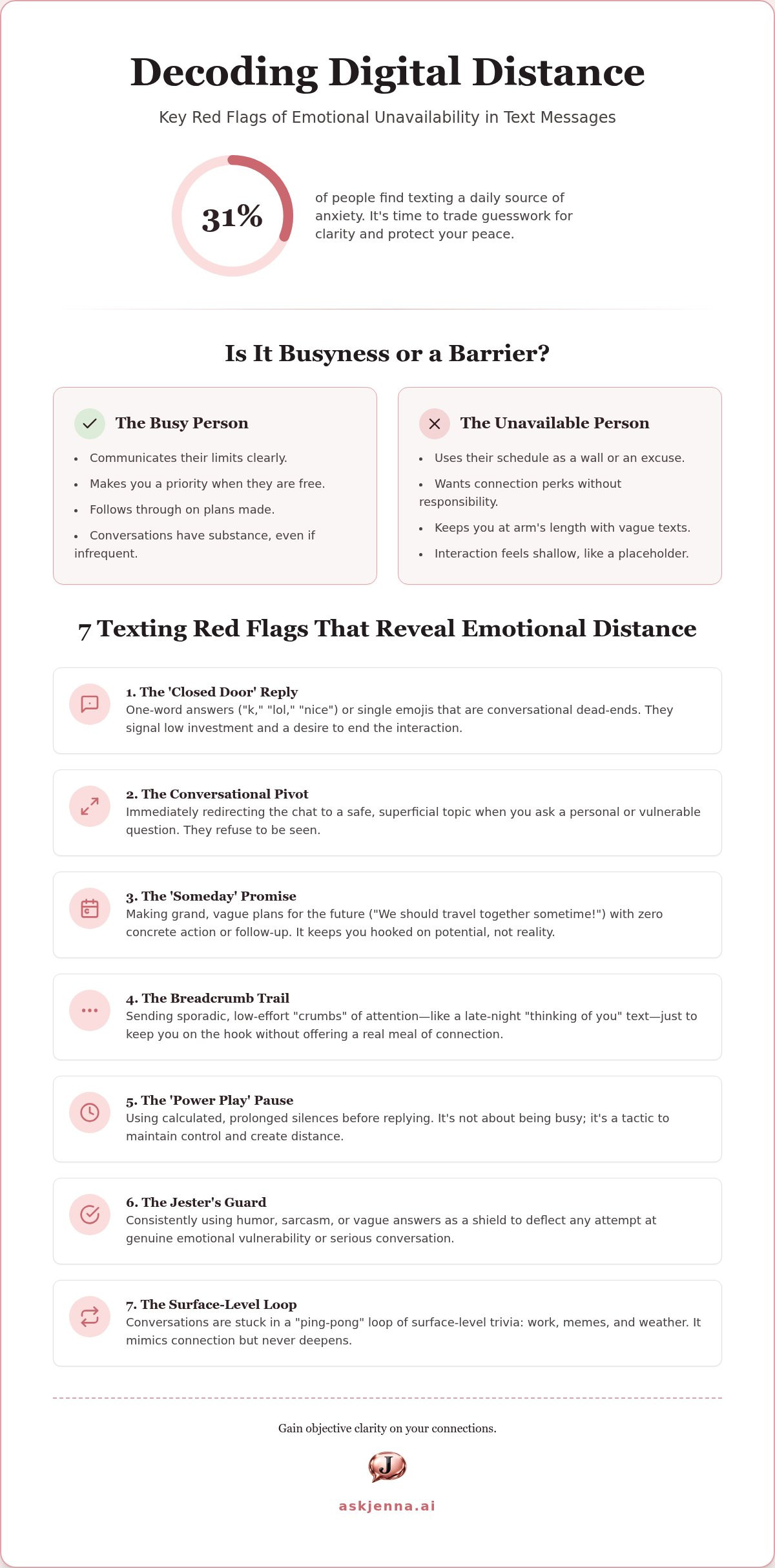
Stop making excuses for their lack of depth. You need to know the difference between a busy person and an unavailable one. A busy person has a full calendar but makes you a priority when they can. They communicate their limits. An unavailable person uses their schedule as a wall. They want the perks of a connection without the responsibility of maintaining it. If you're constantly decoding silence, you're likely seeing the signs of emotional unavailability in text. It's not about their time; it's about their intent.
The Illusion of Connection
Shallow texting creates a dangerous trap. You might exchange fifty messages a day and feel like you're building something real. Look closer at the content. This is often the "ping-pong" effect. You're just keeping the ball in the air without moving the conversation forward. It's a loop of surface-level trivia: work rants, memes, and weather updates. They prefer this digital loop because it mimics closeness. It gives them the ego boost of your presence while keeping the "real-world" version of you at a distance. They are present in your inbox but absent in your life.
Digital Body Language 101
You have to look past the literal words to find the truth. Digital body language is the non-verbal cues found in timing, punctuation, and brevity. It's about the "unspoken" rhythm of your chat history. An emotionally available person naturally moves from safe topics to deep ones. They lean into vulnerability. An unavailable person does the opposite. They treat your personal questions like a hot potato and toss them back to "safe" territory. These are clear signs of emotional unavailability in text that most people ignore. They use brevity as a shield and punctuation as a barrier to keep you from getting too close. Don't ignore the cadence. The rhythm tells you everything the words won't.
The 5 Linguistic Red Flags Hiding in Your Chat History
Your chat history is a receipt. It's a digital trail of intent that reveals exactly how much space you occupy in someone's mind. When you look back through your messages, you aren't just looking for words. You're looking for effort. Many people mistake bad communication for a busy schedule. This is a mistake. Identifying the specific signs of emotional unavailability in text requires looking at what is missing just as much as what is there. If the conversation feels like a heavy lift, it's because you're the only one carrying it.
Deconstructing the Dry Text
One-word answers like "k," "lol," or a single thumbs-up emoji are momentum killers. They are the conversational equivalent of a closed door. Receiving minimal effort in a conversation has a documented psychological impact. It makes you feel small. You start to believe you're "asking for too much" when you're actually just asking for a basic response. Test the waters. Send a vulnerability prompt like, "I'm feeling pretty overwhelmed with work today." An available person asks why. An unavailable person sends a "hang in there" emoji and disappears for six hours. This is low investment at its finest.
The "Pivot" is another subtle defensive move. You ask a personal or deep question, and they immediately redirect the conversation back to surface-level trivia. They refuse to be seen. This is often paired with "Future-Faking." They make grand, vague promises like "we should travel together this summer" but never actually book a flight or even a dinner reservation. These are core signs of emotional unavailability that keep you hooked on potential rather than reality. They are selling you a dream to avoid the reality of a commitment.
Breadcrumbing vs. Real Interest
Breadcrumbing is the practice of sending just enough "crumbs" of attention to keep you on the hook. It's the "thinking of you" text at 11 PM on a Tuesday with no follow-up or plan to meet. These low-effort check-ins serve their ego, not your relationship. They want to know you're still there. They don't actually want to be with you. Watch out for the "zombie" text. This is when they pop up after three weeks of silence with a "hey stranger" as if nothing happened. They aren't reaching out because they miss you. They are reaching out because they are bored.
Inconsistency is the final red flag. One day they are "all in" with paragraphs of text. The next three days they are ghosts. This hot and cold energy is a power play that keeps you off-balance and hyper-focused on their next move. If your chat history looks like a heart rate monitor, it's time to face the truth. You shouldn't need a detective to figure out if someone likes you. If you're tired of the confusion, use Red Flag Detection to get an objective look at your interaction patterns.
Cadence and Timing: The Unspoken Rhythm of Digital Distance
Timing isn't an accident. It's an architecture of distance. When you're looking for signs of emotional unavailability in text, stop reading the words and start reading the clock. The rhythm of a conversation tells you more about someone's intent than a thousand heart emojis. An emotionally available person creates a reliable cadence. They don't leave you hanging for sport. An unavailable person uses timing as a tool for control. They treat your attention like a resource they need to manage rather than a connection they want to grow.
Watch out for the "Power Play" delay. This is the intentional choice to wait hours or days to reply even when they aren't busy. They see your notification. They choose to ignore it to maintain the upper hand. This creates a power imbalance that keeps you anxious and hyper-focused on them. It's a classic move among the signs of an emotionally unavailable person. They want to ensure they are the ones being chased. If the timing feels like a game, you're already losing.
The Midnight Texter
The "U up?" text is the quintessential red flag. It's the ultimate "convenience factor" move. They only engage when they are lonely, bored, or looking for a quick ego boost. They aren't interested in your day or your thoughts; they are interested in your availability. Set a boundary. Stop replying to late-night pings that offer zero substance. If they only have time for you when the rest of the world is asleep, they don't have space for you in their actual life. Real connection happens in the daylight.
Response Latency Patterns
You need to identify the "slow fade" before it becomes a total blackout. This is the gradual increase in response times over weeks. It's a strategic retreat. Don't confuse "work-day busy" with intentional silence. A busy person catches up when the work is done. An unavailable person treats your messages like a chore they are avoiding. Consistent response times are a stronger indicator of health than occasional long bursts of text. Look for the "Vanishing Act"—long periods of silence followed by intense, brief bursts of energy. This isn't passion; it's a way to keep you hooked without providing a steady foundation. Use pattern recognition to see the truth. If their timing is consistently unpredictable, you aren't a priority. You're a backup plan.
Deflection Tactics: How They Dodge Vulnerability in Real-Time
Vulnerability is the price of admission for a real relationship. For the emotionally unavailable, that price is too high. Instead of paying it, they use deflection. This is a strategic pivot designed to keep the conversation on safe, shallow ground. You ask a direct question about their feelings. They respond with a meme. You try to plan a date. They tell you work is "crazy" right now. These aren't just bad habits. They are active signs of emotional unavailability in text. They are protecting their peace by disrupting yours.
Compartmentalization is a huge part of this game. You might text for months without ever hearing about their family, their childhood, or their long-term goals. They keep you in a box labeled "Casual Interaction." If they refuse to let you into their real life, it's because they don't plan on you being in it for long. They want the intimacy of a text thread without the weight of a reality. They are present in your phone but invisible in your world. They are engaging with a screen, not a person.
The Art of the Dodge
The "Stress Shield" is the most common defensive maneuver. They use work or external pressure as a permanent excuse for being distant. Everyone is busy. Not everyone uses that busyness as a weapon. Watch for the "I'm just figuring things out" script. It's a classic stall tactic. It sounds like honesty, but it's actually a way to keep you waiting indefinitely. They might even mirror your energy just to keep you engaged. If you pull back, they suddenly lean in. As soon as you get close again, they dodge. It's a cycle of avoidance that leads to a dead end.
Gaslighting in the DMs
When you finally ask for clarity, they turn the tables. They make you feel "needy" or "too much" for wanting the bare minimum. The "You're overthinking it" response is a conversation killer. It's a subtle form of gaslighting designed to make you doubt your intuition. They want to keep you in "limbo" because that's where they have the most control. You're left analyzing every character while they stay comfortable in the gray area. Stop letting them dictate the terms of your connection. Use our Red Flag Detection to see through the smoke and mirrors and get the truth about where you stand.
From Overthinking to Clarity: AI Decodes the Truth
Your brain is a professional storyteller. When you're faced with silence or a cryptic "k," your mind immediately starts filling in the blanks. You invent complex reasons for their distance. You tell yourself they are overwhelmed at work; they are just "not a phone person;" they're going through a phase. This is the hope filter in action. It's a survival mechanism that keeps you attached to a connection that isn't actually there. You have to strip it away. Objective analysis is the only way to see the truth. You need to identify the signs of emotional unavailability in text without the emotional bias that consistently clouds your judgment.
Ask Jenna's Red Flag Detection is built to be your digital truth-teller. It doesn't care about your shared history or your future hopes. It only cares about the data in the bubbles. It identifies patterns of signs of emotional unavailability in text that you might miss because you're too close to the fire. It's time to shift your perspective. Move from "What does this message mean?" to "Is this the kind of communication I actually want?". Clarity isn't just a comfort; it's a weapon.
The Science of Text Decoding
Linguistic markers don't lie. AI identifies the specific signals of low engagement and avoidant behavior that humans often overlook or excuse. It analyzes word choice, response latency, and emotional sentiment with surgical precision. This isn't about a single bad afternoon or a busy Monday. It's about deep pattern recognition. By looking at your chat history over weeks, you can see the relationship trend. You get a savvy, street-smart confidante in your pocket that tells you exactly what you're dealing with. No more overthinking at 2 AM. No more asking your friends for their biased opinions. Just objective facts.
Taking Your Power Back
Knowledge is power, but decisive action is true liberation. Once you see the "hot and cold" cycle for what it actually is, you can stop the drain on your emotional energy. Use the Response Generation tool to set clear, firm boundaries with confidence. Stop being the only person in the thread putting in the effort. Our journal and pattern recognition feature allows you to track these behavioral trends over time. You will see the unavailability building long before it has the chance to break your heart. Stop the guessing game. Decode your messages with Ask Jenna and get the clarity you deserve. Your peace of mind is worth more than a dead-end text thread with someone who isn't willing to show up. Use the tools at your disposal to protect your time and your heart.
Take Control of Your Digital Peace
You don't have to live in the gray area any longer. Digital distance is a choice. You now know how to spot the architecture of avoidance. From the calculated delays of the "Power Play" to the shallow "ping-pong" of dry texting, the patterns are clear once you remove the hope filter. Recognizing the signs of emotional unavailability in text is the first step toward reclaiming your time. You aren't asking for too much; you're just asking the wrong person. Stop letting vague responses and midnight pings dictate your worth.
It's time to replace confusion with certainty. Use AI-driven red flag detection and objective text decoding to see exactly where you stand. Our pattern recognition journaling helps you track behavioral trends so you can spot the "hot and cold" cycle before it drains your energy. Don't waste another minute dissecting a single bubble. Stop overthinking and start decoding with Ask Jenna to get the clarity you deserve. You have the power to stay or walk away with total confidence. Trust your intuition, use the right tools, and protect your heart.
Frequently Asked Questions
What are the most common signs of an emotionally unavailable man in text?
One-word replies, a total lack of questions about your life, and a refusal to make concrete plans are the most common signs. He keeps the conversation strictly surface-level to avoid any real intimacy or vulnerability. If he constantly pivots away from personal topics or only texts when it's convenient for him, he's intentionally maintaining a digital buffer. He wants your attention without the weight of a real commitment.
Is a 'dry' texter always emotionally unavailable?
A dry texter isn't always unavailable, but you must look at the consistency of their effort. Some people genuinely struggle with digital communication or have high-pressure jobs that limit their screen time. The red flag appears when the "dryness" is selective. If they can engage with others but give you one-word answers, it's a lack of investment. An available person will eventually make an effort to bridge the gap.
How do you respond to a text from an emotionally unavailable person?
Stop over-investing and start matching their energy with surgical precision. If they send a low-effort "k" or a meme, don't reply with a long, thoughtful paragraph. State your needs for clear communication once and see if they adjust. If the pattern continues, stop responding entirely to protect your energy. Your time is a limited resource. Don't spend it trying to pull a conversation out of someone who prefers distance.
Why does he only text me late at night?
He texts you late at night because he's bored or lonely, not because he's invested in you. This is the "convenience factor" in action. He reaches out when his day is over and he wants a quick ego boost or physical connection. If he isn't messaging you during the day to schedule actual dates, he's keeping you in the "low-effort" category. Demand better or stop answering those midnight pings immediately.
Can an emotionally unavailable person change their texting habits?
They can change, but only if they choose to do the hard internal work first. Texting habits are just a symptom of a deeper fear of intimacy or attachment issues. Unless they are actively in therapy or doing serious self-reflection, the pattern will likely repeat. Don't fall in love with someone's potential while ignoring their current reality. Focus on the behavior they're showing you today. If it's not enough, it's time to move on.
How do I tell if someone is breadcrumbing me?
You're being breadcrumbed if you receive occasional, low-effort messages that never lead to a real meeting. These are "crumbs" designed to keep you on the hook without any real commitment. Watch for vague statements like "we should hang out soon" that never turn into a calendar invite. If they're always "thinking of you" but never actually seeing you, they're just managing your expectations to keep you as an option.
What does it mean when someone takes hours to reply but is always on their phone?
It means they're making a conscious choice to put you last on their list. In a world where everyone is glued to their screens, "forgetting to reply" is rarely the truth. If they're posting on social media but ignoring your text, the delay is a power play. They're using digital distance to keep you anxious and maintain control. Stop making excuses for someone who clearly has the time but lacks the intent.
How can AI help me identify relationship red flags in my texts?
AI acts as the objective truth-teller your friends often can't be. It uses Red Flag Detection to identify linguistic markers of low engagement and avoidant behavior that you might miss. By analyzing your chat history, it spots the signs of emotional unavailability in text that are clouded by your own feelings. It removes the guesswork and provides a data-driven look at your relationship's actual potential. Use it to gain immediate clarity and confidence.