 Ask Jenna
Anxious Attachment Texting Patterns: Decode Your Digital Anxiety

You’re staring at a "read" receipt while your chest tightens. You check their "last seen" status for the tenth time this hour; then you regret that three-paragraph essay you sent to a "dry" responder. This isn't just "overthinking." It’s a biological alarm system gone rogue. These anxious attachment texting patterns are digital mirrors of your deepest insecurities, and they’re draining your confidence one notification at a time.
We agree: the spiral is brutal. It turns your smartphone into a source of constant stress rather than connection. You deserve to put the phone down without feeling like your world is ending. By the end of this guide, you’ll stop the obsessive checking and start communicating from a place of power.
Stop the guesswork. We're identifying the 5 specific habits that signal attachment anxiety and providing the blueprint to regain your digital autonomy. You’re about to understand exactly why you feel this way and, more importantly, how to fix it. Let’s get to the truth.
Key Takeaways
- Identify the five specific behaviors, including paragraph-length messages and compulsive checking, that define anxious attachment texting patterns.
- Understand the digital "pursuit-withdrawal" loop and why your attempts to connect often trigger an avoidant partner's retreat.
- Master the "10-Minute Hold" technique to regulate your physical anxiety before you hit send on a message you might regret.
- Leverage objective relationship intelligence to decode hidden red flags and track your communication habits for long-term security.
What Are Anxious Attachment Texting Patterns?
In 2026, your smartphone is more than a tool; it's a direct line to your nervous system. Anxious attachment isn’t a personality quirk or a sign that you’re "needy." It’s a biological response to digital cues. When you operate from this style, your brain treats a delayed reply as a threat to your safety. Scientific study of Attachment in adults reveals that this "alarm system" usually develops in response to unpredictable connections early in life. You aren't being dramatic. You’re trying to survive a perceived abandonment.
Hyper-vigilance is the hallmark of these behaviors. You don't just glance at your notifications. You monitor "Active Now" statuses, calculate response latencies, and obsess over read receipts. Every minute of silence increases the volume of your internal alarm. These anxious attachment texting patterns are your brain's attempt to regain certainty in an ambiguous digital environment. It’s a quest for safety, not a character flaw. Understand that your brain is simply trying to protect you from the pain of being ignored.
The Anatomy of a Texting Spiral
A spiral follows a predictable, painful rhythm. First is the waiting phase; you track the time since your last message with surgical precision. Next is meaning-making. You turn a missing exclamation point into a breakup signal. Finally, you hit the protest phase. You send multiple "check-in" texts to stop the physical chest tightness. You’re trying to force a connection to kill the anxiety.
Digital Body Language You Are Over-Analyzing
Digital communication lacks tone, so you invent it. You watch the "..." typing bubble like a high-stakes thriller. If it disappears without a message, you assume the worst. You also scan for punctuation shifts. A period at the end of "Fine." feels like a cold shoulder. You use emoji frequency as a false barometer for safety. If the hearts stop, you panic. These are anxious attachment texting patterns in action; they represent noise, not the truth of your relationship.
5 Common Texting Habits of the Anxiously Attached
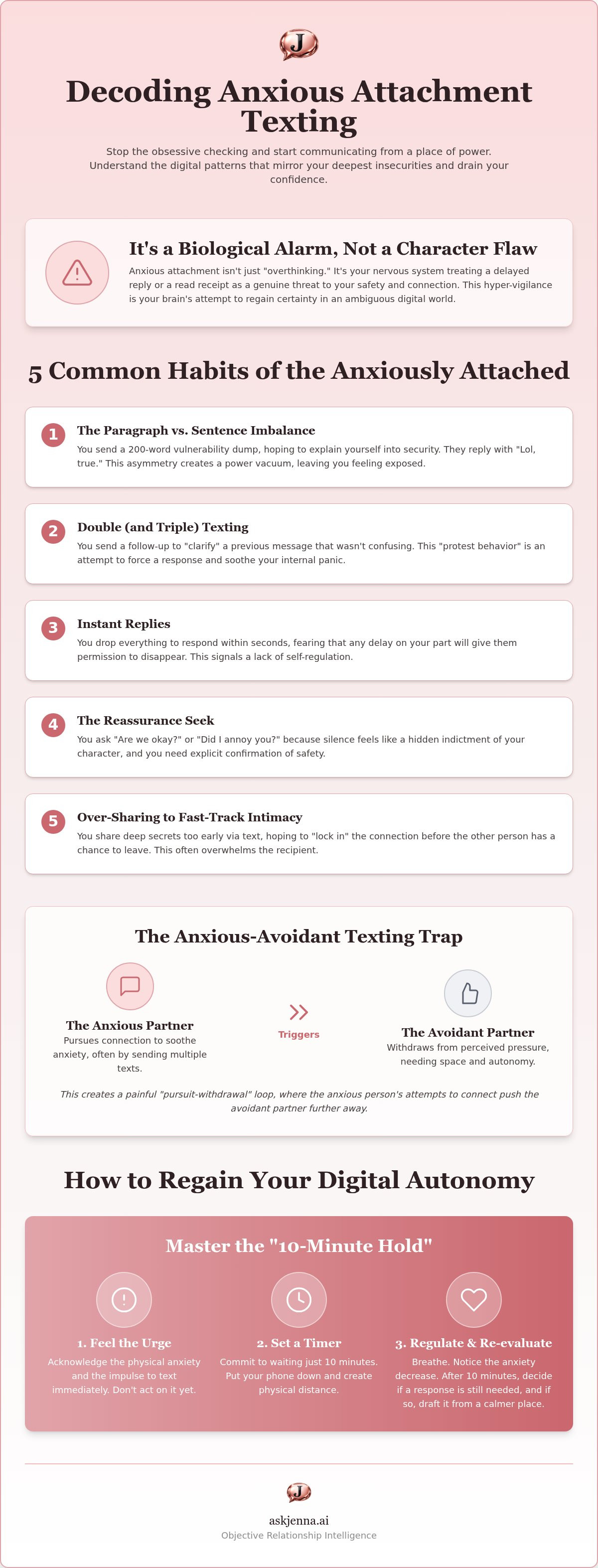
Identifying your specific anxious attachment texting patterns is the first step toward digital freedom. These habits aren't just "texting styles." They are frantic attempts to regulate your nervous system through someone else's phone. When you recognize these behaviors, you take the power back from your anxiety. You stop being a passenger to your impulses and start becoming the driver of your own interactions.
- The Paragraph vs. Sentence Imbalance: You send a 200-word vulnerability dump. They reply with "Lol, true." This asymmetry creates a power vacuum that leaves you feeling exposed and foolish.
- Double (and Triple) Texting: You send a follow-up to "clarify" a previous message that wasn't actually confusing. You’re just checking to see if they’re still there.
- Instant Replies: You drop everything to respond within seconds. You fear that any delay on your part will give them permission to disappear.
- The Reassurance Seek: You ask "Are we okay?" or "Did I annoy you?" because silence feels like a hidden indictment of your character.
- Over-Sharing: You use text to fast-track intimacy. You share deep secrets too early, hoping to "lock in" the connection before they can leave.
Why We Double Text (and Why It Fails)
The act of sending a text provides a momentary dopamine hit. It feels like you’re doing something to fix the silence. However, the "send hangover" hits immediately after. When that second text also goes unanswered, your anxiety doubles. You’ve now given away more of your power for zero return. Protest Behavior is an attempt to force a response to soothe your internal panic, but it usually achieves the opposite. It signals a lack of self-regulation that can drive people away. It creates pressure where there should be flow.
The 'Paragraph' Trap
Insecurity loves a high word count. We think that if we just explain ourselves well enough, the other person will finally provide the safety we need. This is a lie. A "Wall of Text" is overwhelming, especially to avoidant partners who already feel crowded. They don't see your heart; they see a chore. Use the Ask Jenna rule: Match the energy. If you’re struggling to keep it concise, use an objective tool to decode the thread and see if you’re over-explaining. Don't let your need for security turn into a lecture. Less is almost always more.
The Anxious-Avoidant Texting Trap: A Digital Framework
You aren't just texting into a void. You're often texting into a specific type of resistance. When your anxious attachment texting patterns meet an avoidant responder, the "trap" is set. Your pursuit triggers their withdrawal. The more you send "paragraphs," the more they send "K." It’s a toxic feedback loop that feels like a chase where nobody wins. One person is starving for connection; the other is suffocating from the pressure. This is the digital "push-pull" dynamic in its purest form. It turns your phone into a battlefield where the prize is a sense of security that never arrives.
"Dry texting" isn't always laziness. For someone with an avoidant style, it's a shield. They use one-word replies to keep the emotional temperature low. If you respond with more urgency, they retreat further. You must learn to distinguish between your internal trigger and their actual behavior. Are they being distant, or are you just being loud? Stop reacting to the silence. Start observing the pattern. If you don't break the loop, you’ll spend your life chasing people who are running from your intensity.
Decoding 'Dry' and 'Slow' Responders
Is it a red flag or just a busy Tuesday? Look for the baseline. A secure person might be slow on a work day, but they remain consistent. An avoidant person uses silence as a tool for distance. Use Ask Jenna for text message decoding to see through the ambiguity. Our platform provides red flag detection to tell if someone is genuinely unavailable or just emotionally stunted. It acts as the objective "truth-teller" friend who sees through social games. Understanding your anxious attachment texting patterns helps you realize when you are projecting your fears onto their schedule. Remember; waiting isn't always a sign of disinterest. Sometimes, it's just life. Don't let your anxiety fill in the blanks with a horror story. If they are consistently "dry" when you are vulnerable, that is a data point you can't ignore. Use our journal and pattern recognition features to track these shifts over time.
Secure Texting: What Good Communication Looks Like
Digital stability values consistency over intensity. You don't need a three-hour "text marathon" to feel safe. Directness is the gold standard. Say what you mean. Don't play guessing games with emojis or "read" receipts. Set boundaries for yourself. Don't be available 24/7. A secure communicator knows that a phone is a tool for connection, not a leash for validation. They are okay with the silence because their self-worth isn't tied to a notification bubble. They don't use their phone to "check in" on their partner's love. They trust it's already there.
How to Manage Your Anxious Texting Patterns
Understanding your anxious attachment texting patterns is only half the battle. The other half is tactical. You need a system to override your brain's panic mode before you send a message you'll regret. Your phone is a trigger; treat it like one. When the chest tightness hits, you aren't thinking clearly. You're reacting. These five steps will help you move from a state of "activation" to a state of digital autonomy.
- Step 1: Identify the Activation. Your body knows you're anxious before your mind does. Notice the physical cues: shallow breathing, heat in your face, or a racing heart. This is your signal to stop.
- Step 2: The 10-Minute Hold. Put the phone in another room. Set a timer. Adrenaline peaks and fades. If you still feel the need to send that "paragraph" in ten minutes, you can. Usually, the urge passes.
- Step 3: Objective Decoding. Your anxiety sees a threat where there is only a sentence. Use a tool to see the facts. Ask Jenna helps you see if a message is actually a "Red Flag" or just a brief response from a busy person.
- Step 4: Draft and Delete. Write your raw, unfiltered thoughts in your Notes app. Get the "protest" out of your system. Once it's on the screen, delete it. It provides the release without the social consequence.
- Step 5: Pattern Recognition. Use the journal feature in Ask Jenna to track your triggers. You'll start to see that your anxiety follows a schedule. Knowing the "why" makes the "what" less scary.
The Power of Objective Analysis
Your brain is a liar when it’s activated. It hallucinates abandonment because it’s trying to protect you. This emotional layer makes it impossible to read digital body language accurately. AI-driven relationship intelligence strips away that fear. It analyzes the actual content of the thread, not the story you’re telling yourself. Use Ask Jenna to decode your messages and find out if you're dealing with a genuine issue or just a case of "digital overthinking."
Digital Boundaries for Self-Soothing
Lower the stakes of your digital life. Turn off "Read Receipts" and "Last Seen" statuses immediately. These features are fuel for anxious attachment texting patterns. They provide data points that you aren't equipped to handle when you're feeling insecure. Schedule phone-free blocks during your most vulnerable times, like late at night. Replace the compulsive "checking" habit with journaling. When you document your feelings instead of acting on them, you build the "security muscle" you've been missing.
Regain Your Power with Relationship Intelligence
Awareness is a start, but it won't stop the heart palpitations. You can read every book on attachment theory and still find yourself hovering over the "send" button at 2 AM. You need a system, not just a set of facts. Your brain is wired to repeat these anxious attachment texting patterns because they feel like survival. Breaking that cycle requires an objective partner that doesn't get triggered by a missing emoji or a three-hour delay.
Ask Jenna is that partner. Think of it as the "truth-teller" friend who lives in your pocket. It sees through the social games and digital noise that leave you spiraling. By using AI-powered decoding, you move from guessing their intent to knowing the reality. You stop being a victim of digital ambiguity and start becoming a master of your own interactions. It’s time to replace your internal panic with external intelligence.
Pattern Recognition: Seeing the Big Picture
A single text is just a snapshot. A month of data is a map. Ask Jenna’s journaling and pattern recognition tool identifies recurring behavioral trends that you are too close to see. It tracks your triggers and documents how often you fall back into protest behaviors. Seeing the data in black and white provides a level of clarity that emotions can't touch. When you identify the pattern, you gain the confidence to break it. This isn't just about fixing one thread; it's about ensuring you don't carry these anxious attachment texting patterns into your next relationship. You gain the power to choose your responses instead of letting your anxiety choose them for you.
Safe and Efficient Help: Your New Communication Standard
Stop the over-thinking before it drains your battery. If you’re stuck in a loop and don't know how to respond without sounding "needy," get instant help. We provide response generation that keeps your dignity and your boundaries intact. You’ll learn to reply with clarity, not anxiety. Our platform offers red flag detection to alert you when a responder is genuinely toxic rather than just busy. This is about more than just "getting a text back." It’s about building a foundation of digital confidence that changes how you show up in the world. Communicate with security. Act with certainty.
Start decoding your relationship patterns with Ask Jenna today.
Take Control of Your Digital Dialogue
Your phone shouldn't feel like a ticking time bomb. You've identified the habits. You understand the anxious-avoidant trap. Now, it's time to act. These anxious attachment texting patterns don't have to define your love life or your self-worth. You can break the cycle of over-analysis and reactive messaging today. It starts with one decisive move: choosing facts over fear. You've spent enough time staring at typing bubbles; it's time to look at the data instead.
Stop guessing what a "dry" response means. Stop waiting for validation that never arrives from an avoidant partner. You deserve a communication style that feels stable, not stressful. Use objective intelligence to see through the digital murk. Whether you need AI-powered red flag detection or relationship pattern recognition journaling to track your progress, you can finally regain your autonomy. You are no longer a passenger to your impulses.
Decode your texts and stop the spiral with Ask Jenna. Our objective text decoding gives you the clarity you need in seconds. You have the tools. You have the insight. Now, go build the secure connection you deserve. You're ready to lead your own narrative.
Frequently Asked Questions
Is double texting always a sign of anxious attachment?
Context is everything. Double texting is only a sign of anxious attachment texting patterns when it’s used as a tool to soothe your own panic. Sending a quick follow-up about a change in dinner plans is secure communication. Sending a "???" because they haven't replied in an hour is a protest behavior. Look at your intention. If you’re texting to force a connection, it’s attachment-based.
How do I stop over-analyzing every single text message?
Stop treating a text like a riddle to be solved. Your brain fills in the gaps with your worst fears when you lack information. Use an objective tool like Ask Jenna to strip away the emotional layer. By focusing on the literal words rather than the "hidden meaning," you regain your logic. Set a hard rule: if you read a text more than twice, put the phone down.
Why do I feel physically sick when someone doesn't text back?
That nausea is your nervous system entering "fight or flight" mode. When a reply is delayed, your brain perceives a threat to your social safety. This triggers a release of cortisol and adrenaline. It’s a survival mechanism from early life that has been misapplied to your smartphone. Recognize the physical sensation as a false alarm. Deep breathing and physical distance from your device are the only immediate cures.
Can a text message decoder really help with dating anxiety?
A text message decoder acts as the objective, truth-telling friend you need in your pocket. It removes the bias of your own anxiety. By using AI to analyze tone and intent, you get a clear picture of the situation. This stops the mental loop of "what if they hate me?" You move from guessing to knowing. It provides the strategic advantage of seeing red flags before they become heartbreaks.
What should I do if I've already sent a 'wall of text'?
Stop typing immediately. Do not send a follow-up apology for the long message; that just adds to the noise. Leave the "wall of text" where it is and go silent. This allows the other person space to process without feeling further pressure. Use this time to journal your triggers in the Ask Jenna app. Tracking these anxious attachment texting patterns helps you understand why you felt the need to over-explain.
How can I tell if someone is avoidant or just a bad texter?
Bad texters are inconsistent with everyone; avoidants are inconsistent when things get close. A bad texter might take five hours to reply but will be warm and present when they do. An avoidant responder uses "dry" texting specifically to create distance when they feel crowded. Use red flag detection to see if their behavior is a defense mechanism. If they withdraw every time you get vulnerable, they aren't just "busy."
Is it okay to ask for more frequent communication?
It is absolutely okay to state your needs. The key is to do it from a secure place, not a reactive one. Instead of saying "You never text me back," try "I feel more connected when we check in once a day." If they can't meet that simple requirement, you have your answer. Secure people value clarity. If your request triggers a withdrawal, you've detected a red flag early. Don't settle for crumbs.