 Ask Jenna
How to Ask for a Second Date Over Text: 2026 Guide

Most people lose their chance at a second date not because of the date itself, but because of the spiral that happens afterward. You're staring at a blinking cursor. You're overthinking the placement of an emoji. You're wondering if a three-hour response time is a signal or just a busy Tuesday. It's exhausting to play these social games when you just want a straight answer. Learning how to ask for a second date over text doesn't have to feel like a high-stakes gamble. You deserve clarity, not a week of digital anxiety.
We've all been there, stuck in the post-date guessing game. You want to see them again, but you don't want to seem desperate or misread the room. This 2026 guide is your strategic advantage. It's designed to stop the overthinking and replace it with confidence. You'll learn exactly how to craft a message that gets a definitive yes while keeping your dignity intact. We'll break down the psychology of timing, show you how to decode their subtext, and provide specific response generation techniques to ensure your next move is the right one.
Key Takeaways
- Ditch the outdated "hard to get" games. Clarity is your most powerful tool for maintaining post-date momentum and avoiding the limbo phase.
- Discover exactly how to ask for a second date over text using frameworks that project confidence and eliminate digital ambiguity.
- Master Digital Body Language (DBL) to see through polite "thank you" notes and identify genuine emotional availability.
- Learn to decode the "busy" excuse with surgical precision. Know immediately if it's a scheduling conflict or a soft rejection.
- Leverage AI-driven response generation to craft the perfect ask based on your unique conversation history and shared jokes.
The Post-Date Texting Limbo: Why Clarity Beats Games
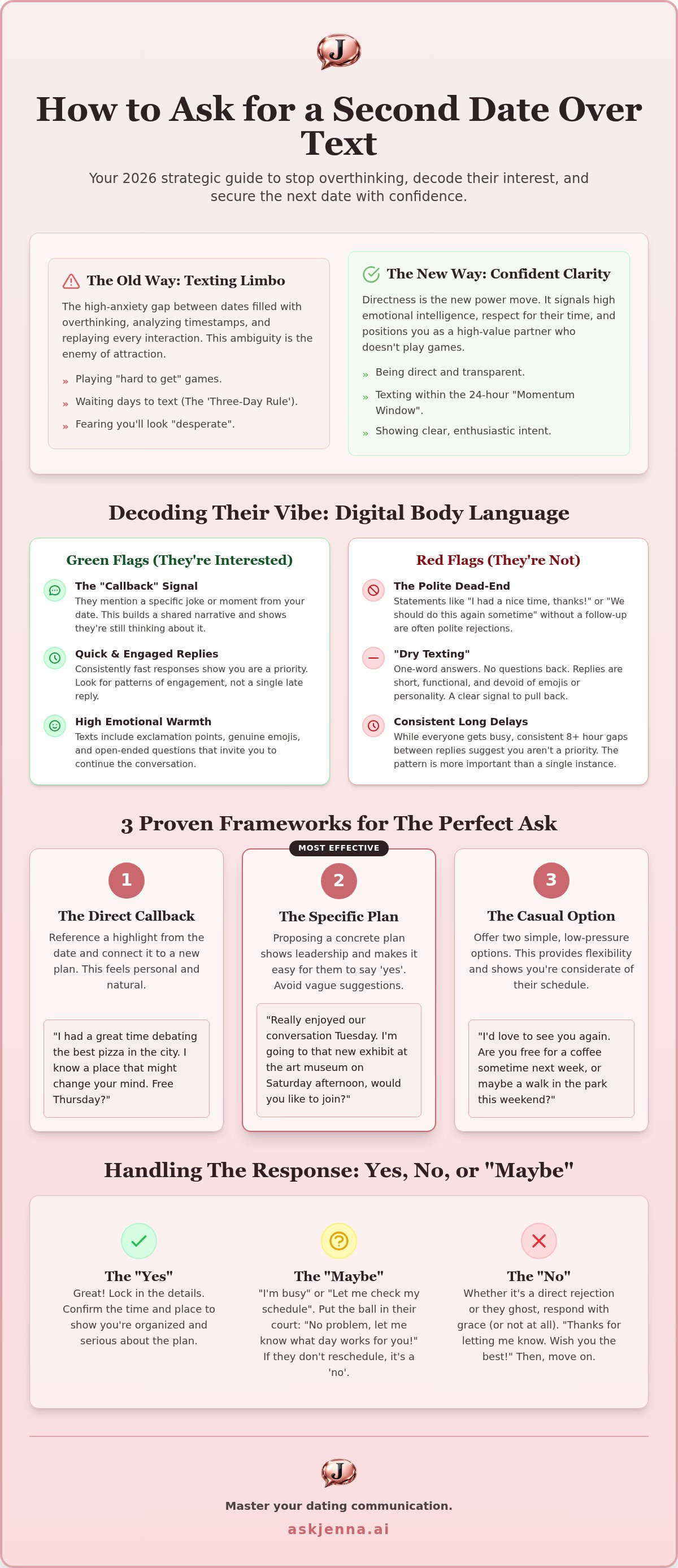
Texting Limbo is the high-anxiety gap between the first date and the second ask. It is a psychological vacuum where confidence goes to die. You replay every interaction. You analyze the timestamp of every message. You wonder if they are "playing it cool" or just not interested. Stop the spiral. Ambiguity is the enemy of attraction. In the evolution of modern dating practices, transparency has become the ultimate power move. If you want to know how to ask for a second date over text, you must first accept that playing hard to get is a 2010s relic that kills momentum.
Transparency is the new cool. When you are direct, you eliminate the "guessing game" that exhausts most singles. Asking early signals high emotional intelligence. It shows you are self-aware, decisive, and respectful of the other person's time. You aren't waiting for a sign from the universe. You are creating the opportunity yourself. This shift from passive observer to active participant changes the entire dynamic of your digital communication.
The Death of the 'Three-Day Rule'
The "Three-Day Rule" is dead. Waiting seventy-two hours to reach out doesn't make you look busy or mysterious. It makes you look disorganized. In a fast-paced digital world, silence is often interpreted as a lack of interest. You have a 24-hour window to capitalize on the energy you built in person. This is your most valuable asset.
The Momentum Window is the period where emotional recall is highest and the positive energy of the date is still fresh. If you wait too long, that spark cools into a polite acquaintance. Reach out while the memory of your laughter is still vivid. It makes the transition to the next meeting feel natural rather than forced.
Intent vs. Desperation
Many people hesitate because they fear looking desperate. There is a massive difference between enthusiasm and clinginess. Having a plan isn't "too much"; it is leadership. People are drawn to those who know what they want and aren't afraid to ask for it. Clinginess is a lack of boundaries. Intent is a clear signal of emotional availability.
When you learn how to ask for a second date over text, focus on being a "truth-teller." If you had a great time, say so. If you want to see them again, propose it. Ask Jenna views clear intent as a major green flag. It removes the subtextual weight that causes people to ghost. By being the one who provides clarity, you position yourself as a high-value partner who doesn't need to rely on social games to get a "yes."
Decoding the Vibe: How to Know They Want a Second Date
Digital Body Language (DBL) is the subtext behind the screen. It is the modern equivalent of eye contact and leaning in. To understand how to ask for a second date over text, you must first become a master of these digital cues. Words are only 10% of the story. The rest lives in the rhythm, the punctuation, and the specific energy of the reply. Stop reading the message. Start reading the intention.
Analyze the "Thank You" text with surgical precision. A polite closer looks like this: "I had a nice time, thanks for the drink!" It is a dead end. An open-ended invitation looks different: "I had a great time, especially when we debated the best pizza in the city." The latter is a hook. It invites a response. If they aren't throwing you a hook, they might be closing the door. If you aren't sure, you can always use text message decoding to see if you are missing a subtle signal.
Spotting "Dry Texts" is essential for self-preservation. When replies become short, devoid of emojis, or purely functional, it is a signal to pull back. High emotional warmth usually translates to exclamation points, specific emojis, and mirrored language. If they are giving you one-word answers, they are likely checked out. Don't chase. Pivot or move on.
Response Time as a Metric
Response time is a data point, not a verdict. Instant replies usually signal high interest and active engagement. They want the conversation to continue. Conversely, consistent 8-hour gaps often suggest you aren't a priority. However, don't over-analyze a single delay. Everyone has a busy Tuesday or a dead battery. Look for the pattern, not the outlier. Ask Jenna's pattern recognition helps identify these shifts in communication frequency so you don't have to guess if they are pulling away or just swamped at work.
The 'Callback' Signal
The "Callback" is the ultimate green flag. If they mention specific moments, jokes, or stories from the date, they are still thinking about the experience. They are building a shared narrative. This is your opening. Be wary of the phrase "we should do this again." In digital dating, this is often a polite "no" unless it is immediately followed by a "when" or a specific activity. To test the waters, use a low-stakes reference to something you discussed. It is a safe and efficient way to gauge their current temperature before you make the official ask.
The Perfect Ask: 3 Texting Frameworks That Work
The "ask" is where most people flinch. You've decoded the vibe and survived the limbo, but now you have to close the deal. Stop overthinking the perfect sentence. When you are learning how to ask for a second date over text, remember that confidence is the primary currency. You aren't asking for permission to exist. You are proposing a high-value experience to someone you enjoyed meeting. Use frameworks that eliminate guesswork and project certainty.
Ambiguity is a momentum killer. If you suggest meeting "sometime soon," you are putting the emotional labor of planning on them. That is a weak move. Always suggest a specific day and time. It shows you have a life, a schedule, and a clear intention. These three frameworks are designed to handle different vibes while maintaining your status as a decisive leader.
- The 'No-Ambiguity' Framework: This is for when the connection is obvious. It is 100% confidence and zero games.
- The 'Inside Joke' Pivot: Use this to lower the stakes. It leverages shared humor to make the second ask feel like a continuation of a fun conversation.
- The 'Specific Event' Lead: This gives them a concrete "yes" or "no" option based on an external activity, like a concert or a pop-up gallery.
Framework 1: The Direct Approach
Template: "I had a great time. Let’s do [Activity] on [Day]. You in?" This works because it is unapologetic. It signals that you are a person with a plan. You aren't waiting around for them to lead the way. Directness eliminates the scheduling tennis that kills vibes. Instead of five texts about "what do you want to do," you settle the logistics in one. It is efficient, bold, and highly attractive.
Framework 2: The Shared Interest Callback
Template: "Since you mentioned you're an expert in [Topic], we should check out [Place] on [Day]." This framework relies on the psychology of active listening. Active listening is a powerful romantic stimulant. It proves you were actually present during the first date. You didn't just wait for your turn to talk; you absorbed their personality. This makes the second date feel earned rather than random. If you are struggling to find the right phrasing for your specific situation, you can use Ask Jenna's Response Generation feature to craft an ask that feels natural to your unique conversation style while keeping the "truth-teller" edge intact.
Handling the Response: Yes, No, and the Dreaded 'Maybe'
The notification pings. This is the moment where most people lose their cool. You've followed the frameworks on how to ask for a second date over text, and now the ball is in their court. How you react to their reply determines whether you maintain your high-value status or fall into the trap of the anxious chaser. Digital communication is a game of restraint. Clarity is your goal, but self-respect is your foundation. Don't let a single message derail your confidence.
The 'Yes' Protocol is simple: lock it in and stop. If they agree to the time and place, confirm the logistics immediately. "Great, see you at 7 at [Place]." Then, put the phone down. Over-texting after a "yes" signals that you are surprised they agreed. It reeks of insecurity. You've secured the date. Now, save the conversation for the actual meeting. Momentum is built in person, not through a marathon of blue bubbles.
Decoding the 'Busy' excuse requires a truth-teller mindset. If they say they are busy but don't offer a specific alternative day, it is a soft rejection. Interested people find time. Uninterested people find excuses. Don't waste energy trying to solve their schedule for them. If it's a "no," take it with total class. A no-pressure exit like "No worries, hope you have a great week" shows you are unbothered. Zero salt. Zero bitterness. This leaves the door open without you looking desperate or entitled.
A 'Maybe' is almost always a 'No' in disguise. Phrases like "Maybe next week" or "I'll let you know" are often used to avoid the discomfort of a direct rejection. Stop chasing the maybe. If they wanted to see you, they would give you a "yes." Chasing a maybe is a fast track to losing your dignity and your time. Move on to someone who is a clear "hell yes."
Spotting Red Flags in the Reply
Identify breadcrumbing before it drains your emotional energy. This happens when they say "yes" to the idea of a date but never commit to a specific time or location. They are keeping you as an option while they scan for other opportunities. If you feel like you're being led on, you need to Analyze Relationship Red Flags: Spot Trouble Early to see if they are emotionally unavailable. Use red flag detection to protect your time from people who only want a digital ego boost.
The 'Pivot' Text
If they can't make the time but seem genuinely interested, they will suggest an alternative. If they don't, use the 'One-and-Done' Rule. Send one follow-up text 24 to 48 hours later to see if they want to reschedule. If they don't reply or remain vague, the conversation is over. The ball is firmly in their court. Don't send a second follow-up. Maintain your style guidance and your self-respect. If you need help staying strong, you can get safe and efficient help to decode their final signals and move forward with confidence.
Master Your Dating Communication with Ask Jenna
Stop the spiral. Your brain is a biased narrator when your heart is on the line. Overthinking is just a slow way to lose interest and momentum. You've learned how to ask for a second date over text, but executing the plan requires a clear head. Ask Jenna provides that clarity. It cuts through the emotional noise by using AI to analyze the subtext of your conversations. No more guessing. No more anxiety. Just direct, actionable intelligence.
Dating is a skill. Like any skill, it requires the right tools to master. Ask Jenna isn't just about sending one text. It's about understanding the entire landscape of your digital interaction. Use Response Generation to craft the perfect follow-up that matches your unique voice. Access safe and efficient help to navigate the moments where you feel stuck. You deserve to move forward with confidence, knowing exactly where you stand at every step of the process. This is the end of the guessing game.
Text Message Decoding in Action
Your friends mean well, but they are usually just as confused as you are. Their advice is rooted in their own past traumas and biases. Ask Jenna analyzes sentiment and emotional availability with objective precision. It detects the subtle shifts in tone that the human eye misses. When you know the truth, you stop wasting time on dead ends. You stop chasing people who aren't interested. Start decoding your chats with Ask Jenna today.
Building Your Relationship Intelligence
Short-term wins are great, but long-term success requires pattern recognition. Use the journal feature to track your interactions and see who you are actually attracting. If you keep hitting the same walls, the data will show you why. Recognition is the first step toward change. Once you've secured that "yes" using our frameworks for how to ask for a second date over text, use the "Profile building" and "Dress the part" features to prepare for the actual meeting.
You aren't just winging it anymore. You are strategically building your relationship intelligence. Every interaction is an opportunity to learn more about human intention and emotional intelligence. Dating is complex, but it doesn't have to be confusing. Ask Jenna is your unfair advantage in a world of social games. Use it to find the clarity you've been looking for.
Take Control of Your Dating Narrative
Success in digital dating isn't about luck. It's about strategy. You've learned that clarity beats social games every time. By ditching the outdated three-day rule and using specific frameworks, you've already separated yourself from the crowd. Mastering how to ask for a second date over text is simply about removing the friction between your intention and their response. Whether you use a direct approach or a shared interest callback, the goal remains the same: total clarity.
Don't let post-date anxiety dictate your next move. You have the tools to decode digital body language and spot red flags before they drain your energy. It's time to replace the guessing game with certainty. With instant AI text analysis and relationship pattern recognition, you can navigate every interaction with surgical precision. Protect your time and your heart by identifying emotional unavailability early.
Stop guessing. Start decoding. Try Ask Jenna for free. Leverage red flag detection for safer dating and gain the strategic advantage you've been missing. You've got the frameworks. You've got the insight. Go get that second date.
Frequently Asked Questions
How long should I wait to ask for a second date over text?
You should reach out within 24 hours of the first date. Momentum is your greatest asset in digital dating. Waiting three days doesn't make you look busy; it makes you look disorganized or uninterested. Send a text while the positive energy is still fresh to ensure the highest emotional recall.
What if they haven't texted me back after the first date?
Send one low-stakes follow-up text to gauge their interest. If they don't reply within 48 hours, the silence is your answer. Don't chase or send a second follow-up. Focus your energy on someone who values your time. Use red flag detection to see if this is a pattern of emotional unavailability.
Is it weird to ask for a second date the next morning?
It isn't weird; it is confident. Asking the next morning shows you're a "truth-teller" who doesn't play social games. It sets a clear tone for the relationship and removes the anxiety of the guessing game. Most people find directness refreshing in a world of digital ambiguity.
How do I ask for a second date if the first one was just 'okay'?
Change the environment entirely. If the first date lacked a spark, suggest a high-energy activity to see if the connection improves in a different setting. When figuring out how to ask for a second date over text in this scenario, keep it low-pressure. A simple "I'd like to see you again in a different setting" is honest and direct.
What are some good second date ideas to suggest over text?
Suggest specific, time-bound events rather than generic meetups. Propose a specific gallery opening, a new taco spot, or a local trivia night. Specificity shows leadership and makes it easier for them to say yes. Avoid the generic "drinks" invite, which often feels like a repeat of the first date.
What should I do if they say they are 'too busy' for a second date?
Stop trying to fix their schedule for them. If they say they are "too busy" without offering an alternative day, it is a soft rejection. Respond with "No worries, let me know if things clear up," and then move on. Don't wait around for someone who treats you as an option instead of a priority.
Can AI really help me write a better text message?
AI removes the emotional bias that usually clouds your judgment. Ask Jenna uses behavioral psychology to provide response generation and subtext decoding. It gives you an objective view of the interaction. This is your strategic advantage for knowing how to ask for a second date over text with zero cringe and maximum clarity.
How do I know if I'm being too pushy over text?
Look at the message ratio and the frequency of your asks. If you've sent two texts without a reply, or if you're asking for a second date after they've already been vague, you're being too pushy. Stop immediately. Give them space to reach out. Confidence is knowing exactly when to walk away.