 Ask Jenna
How to Spot a Liar Over Text: The Science of Digital Deception in 2026

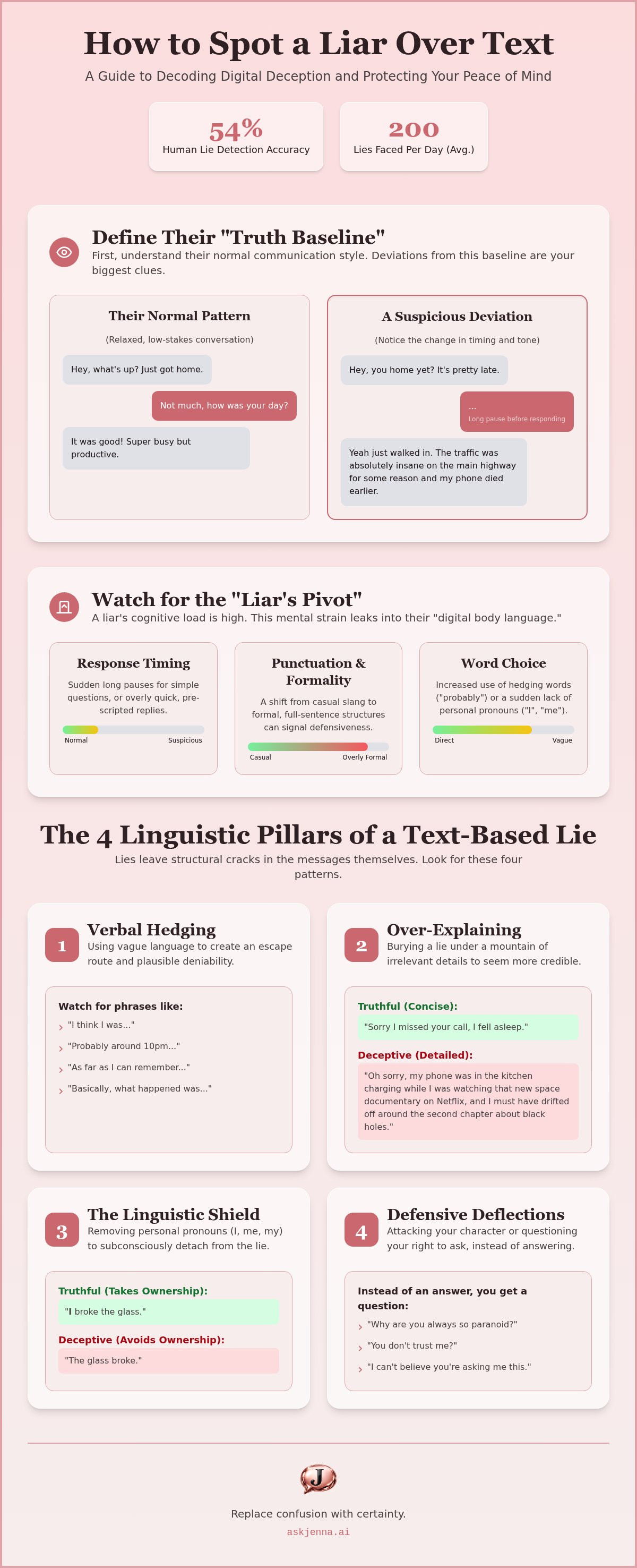
You are lied to as many as 200 times every single day. Research confirms humans only catch about 54% of those deceptions. Behind a screen, the odds feel even worse. You stare at the typing bubble. You wonder if you're being gaslit. You wonder if your intuition is failing. Learning how to spot a liar over text isn't just a social skill in 2026. It's a survival tactic for your emotional peace of mind.
It's exhausting to waste weeks on someone who is only half-honest. You're tired of the ambiguity. You deserve the truth. This guide helps you master the linguistic cues and behavioral shifts that reveal a lie in your DMs before you get played. We will examine the "Liar's Pivot" and the four linguistic pillars of digital deception. You'll walk away with a clear framework to decode every message you receive. No more guessing. No more wasted time. It is time to replace your confusion with total certainty.
Key Takeaways
- Define their "Truth Baseline" to catch the exact moment their digital body language shifts.
- Learn how to spot a liar over text by identifying verbal hedging and the "too much detail" trap.
- Monitor the "Liar's Pivot" for sudden changes in response timing and punctuation formality.
- Use the "Reverse Chronology" test to disrupt their mental script and expose inconsistencies instantly.
- Deploy AI-driven Red Flag Detection to analyze communication patterns and protect your emotional peace.
Beyond Gut Feelings: Why Spotting a Liar Over Text is a Science
Your gut knows before you do. That sinking feeling in your stomach when a "busy" text arrives isn't just paranoia. It's your brain processing data your conscious mind hasn't labeled yet. Digital communication removes traditional body language like eye contact or fidgeting. However, it replaces them with "Digital Body Language." This includes response time, word choice, and even punctuation habits. To master how to spot a liar over text, you must first establish a Truth Baseline. This is the way a person communicates when the stakes are zero. They are relaxed. Their sentences flow. Once you know their normal, the deviations become neon signs of dishonesty.
Ignoring these signs in early dating is expensive. You lose weeks, months, or even years to people who aren't emotionally available. You risk being gaslit into believing your intuition is wrong. The Science of Digital Deception is rooted in observable shifts. When someone lies, they aren't just changing the facts. They are changing their entire linguistic fingerprint. Stop guessing. Start analyzing.
The Psychology of Digital Deception
Lying is a high-effort task. It creates heavy cognitive load. A liar must invent a story, ensure it sounds plausible, and remember not to contradict themselves. This mental strain often leaks into their typing. You might see longer pauses for simple questions or a sudden surge in unnecessary details. The "Distance Effect" also plays a role. The physical gap between screens makes people feel safe. They believe they can't be caught. In this context, Digital Deception is a measurable shift in linguistic complexity and response rhythm used to manipulate perception.
Why Your 'Paranoia' Might Actually Be Pattern Recognition
Don't let anyone tell you that you're just "overthinking." There is a sharp line between anxiety and pattern recognition. Anxiety is a fear of what might happen. Pattern recognition is a reaction to what is already happening. If their "I'm home" text usually arrives at 10 PM but suddenly shifts to 2 AM with a different tone, that is data. It isn't a vibe; it's a deviation.
This is where Ask Jenna's pattern recognition journaling becomes your greatest ally. While your brain might forget a weird text from three weeks ago, the AI remembers everything. It tracks these shifts over time. It decodes the subtle friction between their Truth Baseline and their current behavior. By using AI-driven Red Flag Detection, you move from "feeling" something is wrong to "knowing" it is. Trust the data. It doesn't have an emotional bias. It only sees the truth.
The 4 Linguistic Pillars of a Text-Based Lie
Lies aren't just about the facts provided. They are about the architecture of the message. When someone fabricates a story, their brain works overtime. This effort leaves traces in the text. Research from Brigham Young University indicates that liars often take longer to respond and edit their messages more frequently. These behaviors support The 4 Linguistic Pillars of a Text-Based Lie. If you want to master how to spot a liar over text, you must look for these structural cracks.
- Pillar 1: Verbal Hedging. Using words like "probably" or "I think" to create plausible deniability.
- Pillar 2: Over-Explaining. Burying the lie under a mountain of irrelevant details.
- Pillar 3: The Linguistic Shield. Removing "I" or "me" to distance themselves from the statement.
- Pillar 4: Defensive Deflections. Attacking your character to avoid answering the question.
The Linguistic Shield is a particularly subtle psychological trick. By avoiding first-person pronouns like "I," "me," or "my," the liar subconsciously detaches themselves from the untruth. They might say "The glass broke" instead of "I broke the glass." This lack of ownership is a major red flag in digital conversations. It's an attempt to make the lie feel like an objective fact rather than a personal choice.
The 'Too Much Information' Red Flag
Truth is usually concise. Liars, however, suffer from the "Too Much Detail" trap. They believe that a complex backstory earns them credibility. It doesn't. It just creates more surface area for the lie to fail. A truthful response is often a simple statement: "I fell asleep." A constructed response is a novel: "My phone was in the kitchen while I was watching that space documentary, and I must have drifted off around the second chapter."
Watch for scripted language. If a spontaneous question receives a perfectly polished, multi-sentence excuse, be wary. Real life is messy and fragmented. If their story feels like a movie script, they probably wrote it before you asked. You can use Red Flag Detection to see if these elaborate stories match their usual texting patterns.
Verbal Hedging: The Art of Leaving an Exit
Liars hate being pinned down. They use "hedging" to leave themselves an exit. Phrases like "as far as I remember" or "basically" allow them to change the story later without technically being "wrong." They avoid definitive "Yes" or "No" answers because those are hard to take back. If you ask a direct question and get a "Basically, yeah" in return, you're looking at a hedge. Identifying these non-committal clusters is a core part of how to spot a liar over text. When the language becomes vague, the truth is usually being hidden nearby.
Identifying the 'Liar's Pivot' in Your Chat History
Static lists of "lying words" are useless without context. To master how to spot a liar over text, you must look for the friction between their usual style and their current message. This is the "Liar's Pivot." It is the moment their digital mask slips because the mental effort of maintaining a lie is too high. You aren't looking for a specific word. You are looking for a shift in their established rhythm. When the architecture of their sentences changes, the truth is usually being hidden.
- Response Latency. They answer complex questions instantly but stall on simple ones.
- The Punctuation Shift. They move from casual fragments to rigid, formal full stops.
- Syntax Breakdown. Their normally articulate flow becomes choppy or incoherent.
- Emoji Over-Correction. They use humor or excessive emojis to mask a tense fabrication.
Syntax breakdown is a major indicator of high cognitive load. When someone is lying, their brain is busy managing the deception; this leaves less energy for proper grammar. If a person who is usually well-spoken starts sending garbled, messy, or circular sentences during a confrontation, they are struggling to keep their story straight. Stress breaks their flow. Watch for the moment their "digital voice" starts to crack.
Monitoring Response Timing and Cadence
A 5-minute delay on a "Where are you?" text is a data point. It isn't a verdict on its own. However, if they usually reply to logistics in seconds, that delay matters. It suggests they are constructing an answer rather than reporting a fact. Watch the typing bubble. If it appears, disappears, and reappears multiple times, they are rewriting. They are polishing a lie. Ask Jenna's pattern recognition journaling tracks these statistical anomalies over time. It identifies when their response cadence deviates from the norm, giving you clarity instead of just a "weird feeling."
Sudden Changes in Digital 'Tone of Voice'
The move from "lol" to full stops signals a shift into defensive mode. Sudden formality is a psychological wall. They are policing their language to avoid mistakes. You might also notice vocabulary mirroring. This happens when a liar subconsciously adopts your specific phrasing to build false rapport. They want to feel "in sync" with you so you won't question them. If they suddenly start using your slang during a tense talk, be alert. Finally, identify the "Aggressive Pivot." This is when a simple question about their day turns into an unprovoked attack on your "trust issues." If they can't defend the lie, they will attack the asker. It is a diversion tactic designed to make you stop digging. Don't fall for it. Use how to spot a liar over text techniques to stay focused on the data.
The Strategic Interrogation: How to Reveal the Truth Without a Fight
Direct confrontation is a trap. If you ask "Are you lying?", a dishonest person will simply double down. They've already committed to the fabrication. Instead, use strategic interrogation to create friction. This isn't about an argument. It's about a stress test. When you know how to spot a liar over text, you don't need to shout. You just need to observe. Use the data to your advantage.
Start with the 'Unexpected Question' technique. Liars usually prepare for the obvious "Where were you?" inquiries. They have a script. Disrupt it. Ask about a minor, peripheral detail they wouldn't expect to be relevant. If they are lying, their cognitive load will spike. They have to invent a new fact on the fly while ensuring it doesn't contradict the old ones. This is where the syntax breakdown we discussed earlier often begins.
Next, try the 'Reverse Chronology' test. Ask for the events in a different order. Truth is stored as a multi-dimensional memory. Lies are stored as a linear script. Recounting a story backwards is nearly impossible for a liar without tripping over their own words. Finally, use silence. Send your question and wait. Let the "..." bubble do the work. The pressure of the silence often forces a liar to over-explain, providing more data for you to analyze. This is a primary way how to spot a liar over text without ever raising your voice.
The Art of the Non-Accusatory Question
Stop asking "Why." It sounds like an accusation and triggers an immediate defensive response. Instead, use "What." "What happened after that?" or "What was the atmosphere like?" encourages them to provide more detail. Lies crumble under the weight of specific details. A truthful person will give you concrete facts. A liar will give you vague, non-committal language. By lowering their defenses with non-judgmental curiosity, you create the perfect environment for the truth to surface.
Spotting the 'Deflect and Project' Maneuver
Be ready for the "Deflect and Project" maneuver. This is "Gaslighting Lite." When a liar feels cornered, they will try to make you the problem. You'll hear things like, "I can't believe you don't trust me after everything," or "Why are you always so paranoid?" This is a classic diversion tactic. They are trying to move the conversation from their behavior to your character. Don't take the bait. Stay objective.
If the conversation feels like a mental maze, it's time for professional backup. You can use Ask Jenna's Red Flag Detection to identify these manipulative "turnaround" phrases in real-time. It flags the projection so you can stay focused on the facts. Don't let a "Benefit of the Doubt" trap keep you in a dishonest situation. Empathy is a virtue, but it shouldn't be a blindfold. Trust the patterns, not the apologies.
Automating Deception Detection with Ask Jenna
Manual analysis is exhausting. You're scrolling through months of chat history. You're trying to remember if they always used that many full stops. You're biased because you want to believe them. This is where manual efforts fail. Learning how to spot a liar over text shouldn't feel like a full-time job. AI doesn't have feelings. It doesn't have "hope" that they're telling the truth. It only has data.
Ask Jenna's Red Flag Detection provides real-time analysis of manipulation. It looks for the linguistic pillars we've discussed, such as verbal hedging and the removal of first-person pronouns. It identifies the "Liar's Pivot" before your conscious mind can process the friction. You move from a place of paralyzing suspicion to objective certainty. This is the peace of mind that comes from having an expert 3rd party in your pocket. It is a definitive solution for anyone tired of wondering how to spot a liar over text manually.
How Ask Jenna Decodes the Unspoken
The platform uses behavioral psychology and pattern recognition to decode your DMs. It looks for more than just lies. It identifies emotional unavailability and the early signs of love bombing. These patterns often hide in plain sight. A liar might be consistent in one conversation but fail when compared to their three-month baseline. Ask Jenna's pattern recognition journaling tracks these relationship trends you're too close to notice.
The system provides safe and efficient help. It doesn't just tell you someone is lying. It suggests the right response to a suspected lie. This prevents the "Deflect and Project" maneuver we covered earlier. You stay in control of the narrative. By analyzing linguistic complexity and response rhythm, the AI bridges the "Digital Body Language" gap that humans struggle to navigate alone.
Your Secret Weapon for Modern Dating
Dating in 2026 is complex. Identity fraud victims for new accounts increased by 31% between 2024 and 2025. Deepfake-enabled fraud is projected to rise by 495% this year. You need a digital ally to filter out the noise. Humans only catch about 54% of lies on their own. Those aren't great odds when your heart and your time are on the line.
Protecting your emotional energy is the only way to find a genuine connection. Don't waste your time on people who aren't being real. Stop guessing. Stop letting ambiguous messages ruin your night. Use the tools designed for the digital age. It is time to Stop overthinking and start decoding with Ask Jenna. Your peace of mind is worth the clarity.
Take Control of Your Digital Truth
Deception in 2026 is sophisticated, but it isn't invisible. You now have the tactical tools to identify the "Liar's Pivot" and recognize when someone is hiding behind a linguistic shield. Mastering how to spot a liar over text is about more than catching a single untruth. It's about protecting your time, your heart, and your mental health from calculated manipulation. You don't have to live in a state of constant doubt or exhausting overthinking anymore.
Stop playing social games and start using objective data. Ask Jenna provides AI-powered Red Flag Detection and no-nonsense behavioral insights used by thousands to navigate the complexities of modern dating. It's time to replace your anxiety with total certainty and move forward with confidence. Stop the guesswork. Use Ask Jenna to decode their texts now. You deserve a relationship built on radical transparency. Trust your intuition, verify with the facts, and reclaim your emotional peace of mind today. The truth is waiting for you.
Frequently Asked Questions
What are the most common phrases liars use over text?
Liars often use "filler" phrases to sound more convincing. Watch for "to be honest," "honestly," or "believe me." These are verbal crutches used to bolster a weak story. They also rely on qualifiers like "basically" or "actually" to soften the impact of a fabrication. If someone suddenly starts insisting they are telling the truth without being prompted, they are likely doing the opposite. Trust the baseline, not the emphasis.
Is a long response time a definite sign of lying?
A long response time isn't a verdict; it's a deviation. You must compare the delay against their established Truth Baseline. If they usually reply in seconds but stall for ten minutes on a simple question, they are likely constructing a narrative. Watch for a flickering typing bubble. This suggests they are editing and polishing a lie. Context is everything. One slow reply is a glitch; a pattern of delays is a red flag.
How can I tell if someone is gaslighting me over text?
Gaslighting over text involves a direct attack on your perception of reality. Look for phrases like "You're overthinking it" or "That never happened." They shift the focus from their behavior to your mental state. This is a common defensive pivot. If you feel confused or guilty after asking a valid question, you're being manipulated. Use Ask Jenna to flag these turnaround phrases and stay grounded in the facts of the conversation.
What should I do if I catch someone in a lie via text?
Stay calm and document the evidence immediately. Don't launch into an emotional attack; it gives them an opening to call you "crazy." Instead, use the unexpected question technique to see if their story holds up under pressure. If they continue to lie, you have the data you need to make a decision. Objective proof is your greatest leverage. Protect your peace by stepping back from the drama and staying objective.
Can AI really detect if someone is lying in a message?
AI is significantly more effective at detecting deception than the human brain. While humans only catch about 54% of lies, AI analyzes thousands of linguistic data points in seconds. It identifies shifts in complexity, response rhythm, and pronoun usage that you might miss. Ask Jenna's Red Flag Detection provides an objective 3rd party perspective. It's an essential tool for anyone learning how to spot a liar over text in 2026.
What is 'verbal hedging' and why does it matter?
Verbal hedging is the use of non-committal language to avoid being pinned down. Phrases like "I think," "maybe," or "as far as I know" provide a built-in exit strategy. If the truth later comes out, the liar can claim they weren't technically lying. It matters because it signals a lack of certainty and ownership. Truthful people speak in definitive terms. Liars hide behind qualifiers to maintain plausible deniability and avoid being caught.
How do I confront a liar without sounding 'crazy'?
Avoid emotional accusations and stick to the observable data. Instead of saying "I know you're lying," ask "What happened after you left the office?" Use "What" instead of "Why" to keep their defenses low. If their answer contradicts the facts you already have, let the silence sit. You don't need to yell to win. The goal is to collect information, not to start a fight. Focus on the patterns you've identified.
Why do people lie more over text than in person?
Digital communication creates a "Distance Effect" that makes lying feel safer. Without eye contact or immediate social feedback, the brain feels less stress during a fabrication. Texting also provides the gift of time. Liars can carefully craft, edit, and polish their responses to ensure they sound plausible. This is why learning how to spot a liar over text is more difficult than spotting one in person. The screen acts as a shield.