 Ask Jenna
How to Track Relationship Trends: Stop Guessing and Start Decoding Patterns

Your intuition isn't a strategy, and "vibes" aren't data. You spend hours dissecting a single comma in a text message while the bigger picture remains a total blur. It's frustrating. You're likely exhausted by the burnout of repeating the same mistakes and missing red flags until it's far too late. You deserve to know exactly where you stand without the constant mental gymnastics. It is time to stop guessing and start using real-time data to track relationship trends with surgical precision.
You already know that patterns don't lie, even when people do. We're moving past the guesswork. This guide shows you how to use AI-driven relationship intelligence to decode behavioral shifts and spot emotional unavailability before you're too deep. You will learn how to audit your digital interactions, identify hidden red flags, and gain the objective proof you need for total decision-making confidence. We are breaking down the tools that turn emotional confusion into a strategic advantage. Stop overthinking. Start decoding.
Key Takeaways
- Stop letting ambiguity drain your energy; learn why data is the only way to gain objective clarity in your dating life.
- Decode "digital body language" to understand the unspoken messages and power dynamics hidden within every text exchange.
- Implement a 4-step framework to track relationship trends and identify the recurring "Opening Act" of your past failed situationships.
- Switch from biased manual journaling to AI-powered pattern recognition to see your relationship health without the rose-colored glasses.
- Leverage real-time text decoding and red flag detection to end the overthinking loop and respond with total confidence.
Why Tracking Personal Relationship Trends is Your New Dating Superpower
Ambiguity is a slow poison for your emotional health. You tell yourself you're being "chill" or "going with the flow," but your brain is actually on fire trying to solve a puzzle with missing pieces. Stop. Data is the only thing that provides the objectivity your heart tries to ignore. Your heart wants to believe the best; your data knows the truth. Trends reveal character with a speed that single conversations can't match.
Most people suffer from "dating amnesia." You forget the three times they "forgot" to text back because the fourth time they were charming. Tracking prevents this cycle. It forces you to look at the cold, hard facts of how you're being treated. When you track relationship trends, you stop living in the "maybe" and start living in the "is." It's about auditing behavioral data to protect your peace.
The Shift from Intuition to Intelligence
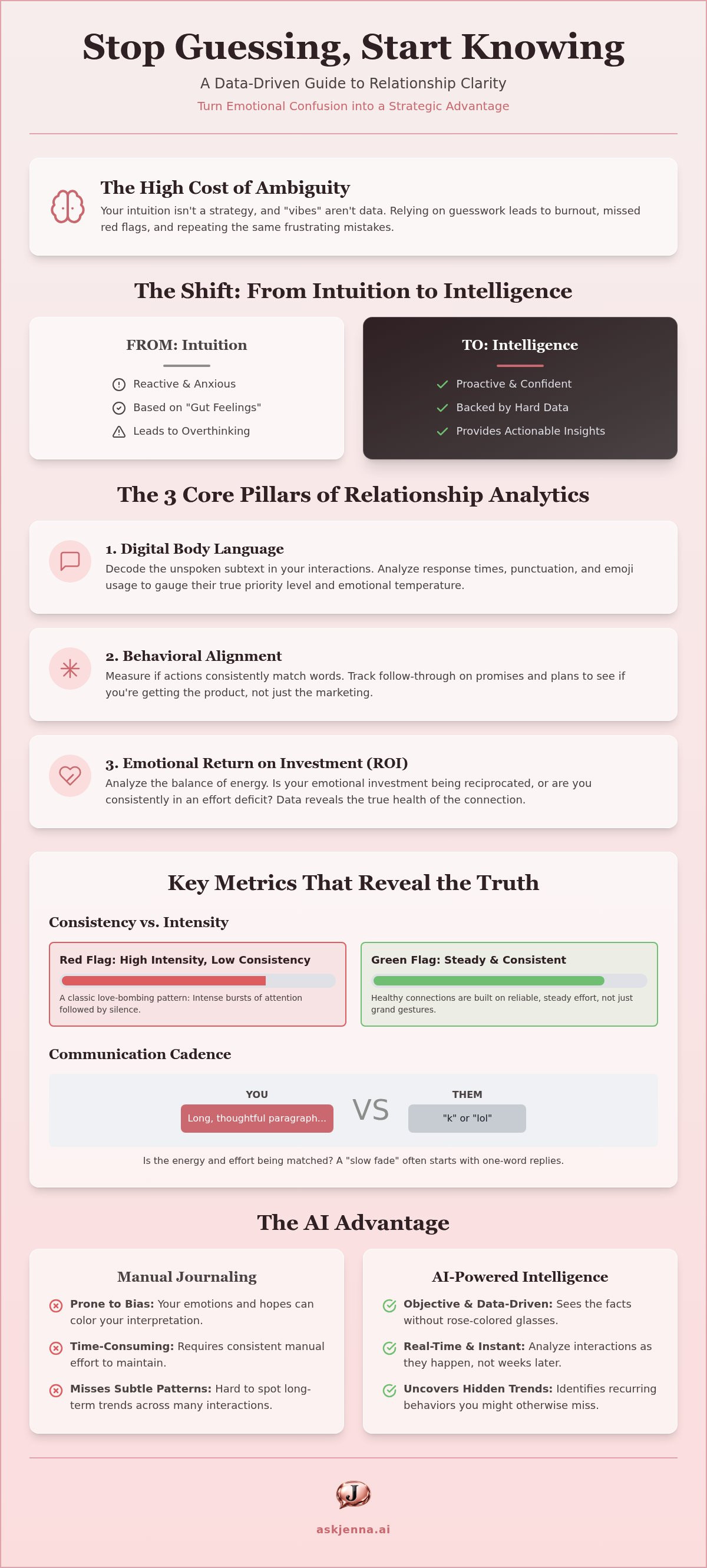
Your gut feeling is a great starting point, but it's not enough in the digital age. Screens sanitize lies. A "gut feeling" can easily be dismissed as anxiety or overthinking. Intelligence is different. It's proactive. You move from reacting to every single notification to recognizing the patterns behind them. This shift replaces constant anxiety with actionable insights. Instead of asking "Why did they say that?", you ask "How does this fit into their established behavior?"
While academic theories of interpersonal relationships explain the general stages of human connection, your personal analytics explain your specific reality. You're no longer guessing; you're observing. You are moving from a place of vulnerability to a place of strategic advantage.
What You Should Actually Be Tracking
Don't track everything. Track what matters. Focus on the metrics that define the health of your connection. You need to track relationship trends to see these shifts in real time. Intensity is easy; consistency is hard. If the data shows a drop-off in effort, believe the data. Don't believe the excuses.
- Communication Cadence: Is the energy being matched? Look for the "slow fade." If your messages are paragraphs and theirs are fragments, you have your answer.
- Emotional Availability: Are they actually opening up, or are they just performing? Track if they share real details or keep things surface-level.
- Consistency vs. Intensity: This is the ultimate red flag detector. High intensity followed by total silence is a classic love-bombing trend. Real health is found in the steady middle.
Patterns don't lie. When you see the trend line heading down, you can make a decision before you're too emotionally invested to leave. That's not being cynical. That's being smart.
The 3 Core Pillars of Individual Relationship Analytics
You can't manage what you don't measure. In modern dating, the "vibe check" is an outdated and unreliable metric. You need a framework that cuts through the noise of your own hope. Current research on relationship trends highlights how dating and stability have shifted significantly over the last few decades. This shift requires a new set of tools. To truly track relationship trends, you must focus on three non-negotiable pillars: digital body language, behavioral consistency, and emotional ROI.
Decoding Digital Body Language Trends
Every text is a data point. Digital body language is the unspoken subtext of your interaction. It isn't just about the words on the screen. It is about the cadence and the delivery. Analyzing response times helps you see the priority level you hold. Don't obsess over minutes. Look for the average. Is the gap between replies lengthening? That is a trend, not a busy day.
Punctuation and emojis are your tone indicators. A sudden drop in exclamation points or the disappearance of "your" emoji isn't a coincidence. It's a shift in temperature. Identifying "dry texting" early allows you to address the decline in interest before you're ghosted. If you're struggling to read between the lines, text message decoding can provide the clarity you're missing instantly. Stop the overthinking loop and see the data for what it is.
Measuring Behavioral Alignment
Words are the marketing; actions are the product. Behavioral consistency is the only way to measure if someone is actually who they say they are. You need to track relationship trends regarding follow-through. Does the "I'm so busy" excuse happen every time you suggest a weekend plan? That's not a schedule conflict. That's a pattern of avoidance. If their words promise a future but their actions only offer a Tuesday night at 10 PM, the data is screaming.
Watch for the "Breadcrumbing" cycle. This is characterized by intense highs followed by sudden, unexplained lows. It's designed to keep you hooked with the minimum viable effort. Similarly, the "Slow Fade" is a strategic withdrawal. Their replies get shorter. Their "availability" shrinks. Recognize these trends for what they are: a lack of investment. Patterns reveal the truth that "I'm just bad at my phone" tries to hide.
Finally, audit your Emotional ROI. A healthy relationship should be a net gain for your energy. If you spend more time decoding their behavior than enjoying their company, the ROI is negative. Trends in your own mood are just as important as theirs. If your tracking shows a steady climb in your own anxiety, the data is telling you to walk away. Protect your peace with proof.
Manual Journaling vs. AI Relationship Intelligence
Manual journaling is a legacy system. It is slow. It is biased. Most importantly, it is often a work of fiction. When you try to track relationship trends by hand, you are fighting your own biology. Your memory is selective. Your heart is an unreliable narrator. You need a system that doesn't have feelings. You need the cold, hard truth that only data can provide.
The stakes couldn't be higher. Long-standing Harvard research on relationship quality proves that the health of your connections is the single greatest predictor of long-term happiness. If your life satisfaction depends on your relationships, why would you rely on a biased, handwritten diary? AI removes the rose-colored glasses that you wear after a decent date. It replaces "I think they like me" with "The data shows a 40% decrease in engagement."
Efficiency is the ultimate game changer. Analyzing a screenshot takes seconds. Writing a diary entry takes twenty minutes of emotional labor. In the time it takes you to find a pen, AI has already decoded the subtext of a three-month conversation. You need real-time answers to navigate modern dating, not a retrospective reflection written three weeks too late.
The Pitfalls of Traditional Dating Journals
Recency bias is the biggest killer of objectivity. You have one great Friday night and suddenly the previous three weeks of breadcrumbing disappear from your mind. You aren't lying; you're just human. You also likely filter your entries. You write what you want to be true to protect your ego. Finally, there is the time suck. Most people abandon a physical journal in under fourteen days. It is a chore that adds to your dating burnout rather than solving it.
How AI Automates Pattern Recognition
AI relationship intelligence changes the math entirely. It provides instant red flag detection by scanning months of digital interaction in a heartbeat. It sees the "slow fade" before you've even felt the chill. Objective sentiment analysis tells you what the tone actually is, not what you hope it is. You get automated trend reports that show you the big picture without the emotional baggage. You stop being the detective and start being the one with the answers. It’s about working smarter, not harder, to track relationship trends that actually matter.
A 4-Step Framework to Identify Your Dating Patterns
Generic dating rules are useless because they aren't personal. You don't need a generic "333 rule" from a lifestyle blog. You need a forensic audit of your own history. To track relationship trends that actually matter, you have to look at your own data. Stop looking forward for a second and look back at the wreckage. This 4-step framework will reveal the patterns you've been blind to.
Step 1: Audit your archive. Open your message history. Look at your last three failed situationships. Don't look at the highlight reel. Look at the end. Step 2: Identify the "Opening Act." How did these people start? Was it an explosion of attention? Was it a slow burn that never caught fire? You'll likely see they all followed the same script. The faces change, but the dialogue stays the same.
Step 3: Spot the "Mid-Game Shift." This is the exact moment the energy changed. It's the pivot from "I can't wait to see you" to "I'm just really slammed this week." Mark the date. Step 4: Use AI to find the common denominator. The common factor in all your failed romances is usually the "type" you choose or the specific red flags you choose to ignore. AI sees this immediately because it doesn't have an emotional bias toward charm or physical attraction.
Auditing Your Communication History
Go deep into your past chats. Find the first sign of a "dry text." That one-word reply was the beginning of the end. Notice who initiated the deep conversations. If it was always you, the relationship was lopsided from day one. Identify the specific moment emotional unavailability became obvious. Usually, it's right after you expressed a real need or boundary. Seeing this clearly helps you track relationship trends in your current dating life before history repeats itself.
Breaking the Cycle of Toxic Trends
Awareness is nothing without action. Set "Pattern Triggers" for yourself. If someone cancels twice without a specific reschedule, you leave. No exceptions. No "maybe they're just stressed." You can also use style guidance to change how you present yourself and attract a different demographic. When you use pattern recognition journaling, focus on how you actually felt during those "Mid-Game Shifts." Did you feel anxious, small, or ignored? Those feelings are data points. Use them to build a wall against the same old mistakes. Stop the cycle. Start the decoding.
Ask Jenna: The Intelligence Platform for Modern Relationships
Passive observation is for amateurs. You need a strategic advantage. Ask Jenna moves you beyond simple tracking and into the world of active relationship intelligence. It is the digital equivalent of a wise, protective friend who sees through every social game. When you use this platform to track relationship trends, you aren't just watching things happen. You are taking control of the narrative.
Text Message Decoding is your first line of defense. It stops the overthinking loop instantly. Stop wondering why they used a period instead of an exclamation point. Ask Jenna analyzes the subtext and gives you the truth. Red Flag Detection works in real-time to spot unspoken warnings. It identifies emotional unavailability before you waste another month on a dead-end connection. Our pattern recognition journaling then connects the dots for you automatically. It reveals the behavioral shifts you might miss in the heat of the moment.
Your Digital Confidante and Strategist
Ask Jenna does more than just analyze; it acts. Our response generation helps you reply with safe and efficient help. Keep your dignity intact while keeping the vibe alive. We also offer profile building and "dress the part" insights to help you attract the trends you actually want. It is about being prepared for the hardest conversations with a strategist in your pocket. You get the tactical edge in every interaction. Replace your anxiety with a decisive plan of action.
Take Control of Your Romantic Future
Waiting for "luck" is a losing strategy in 2026. The dating market is too complex for hope alone. You need objective insight in an emotional world. Data removes the fog of war from your dating life. It replaces confusion with certainty and confidence. You now have the tools to track relationship trends with surgical precision. Stop guessing. Start winning.
Start tracking your relationship trends with Ask Jenna today.
Take Back Your Narrative
You've spent enough time in the "maybe." You've analyzed every blue bubble until your head hurt. Now you have the framework to flip the script. Stop relying on hope and start relying on evidence. When you track relationship trends, you aren't being cynical; you're being strategic. You're protecting your time and your emotional health from people who only offer ambiguity. Patterns are the only map that matters in the digital dating landscape.
Clarity is a choice. You can continue the cycle of "dating amnesia" or you can use the intelligence available to you. AI-powered red flag detection and instant text message decoding give you the objective proof you need to make better emotional decisions. Don't wait for the next situationship to fail before you decide to change your approach. The data is already there. You just need to read it with the right eyes.
Stop overthinking and start decoding with Ask Jenna. You deserve a relationship that adds to your life instead of draining it. Take the lead. Your future self will thank you for the clarity you find today. You've got this.
Frequently Asked Questions
How do I track relationship health without being obsessive?
Focus on long-term patterns rather than single messages. Obsession comes from reacting to every text in real-time; tracking health involves looking at the weekly trend line. Use automated tools to do the heavy lifting so you don't spend your day manual-checking timestamps. It is about auditing the energy, not the minutes. Set a specific time to review your data so it doesn't bleed into your daily life.
Can an AI really detect if someone is emotionally unavailable?
Yes, AI identifies linguistic markers like distancing language, lack of personal disclosure, and inconsistent engagement. It looks for specific word choices and shifts in sentiment that human hope often ignores. By analyzing thousands of data points, it spots the "avoidant" script before you have even finished the third date. It recognizes the pattern of pulling back the moment things get real.
What are the most common relationship red flags in 2026?
Breadcrumbing and the "slow fade" remain the top digital warnings this year. Watch for "micro-ghosting," where someone stays active in your social media likes but disappears from your direct inbox. Another major flag is high intensity early on followed by a total drop in communication cadence. These are clear signs that the investment is surface-level and unlikely to lead to any real stability.
Is it weird to use an app to analyze my dating messages?
It isn't weird; it is a strategic advantage in a complex digital environment. You already use apps to find people, so using them to understand those people is the next logical step. It provides the objectivity you lose when you are emotionally invested. Think of it as a digital confidante that keeps you grounded when the "vibes" get confusing and the subtext is murky.
How long does it take to see a pattern in a new relationship?
You can usually identify a clear pattern within 14 to 21 days of consistent interaction. This timeframe is long enough to see if their initial "best behavior" holds up against real-life stress or scheduling conflicts. If you track relationship trends over these first few weeks, the data will tell you if they are reliable or just performing for a temporary "Opening Act."
What is the difference between a dating trend and a one-time mistake?
Frequency is the only differentiator. A one-time mistake is an outlier; a trend is a repeated behavior that happens three or more times. If they forget to call once, it is a slip. If they forget every Thursday, it is a trend. Tracking helps you distinguish between a bad day and a bad character trait, ensuring you don't overreact or under-react to isolated incidents.
Can tracking relationship patterns help me avoid ghosting?
It helps you predict ghosting before it happens so you can protect your peace. Ghosting rarely happens out of nowhere; it is almost always preceded by a "slow fade" in communication cadence and a drop in emotional ROI. When you track relationship trends, you see the withdrawal early. This allows you to walk away with your dignity intact before they have the chance to disappear completely.
How does AI text decoding actually work?
AI text decoding uses sentiment analysis and natural language processing to identify the subtext of a conversation. It looks at word choice, response time, and punctuation to determine the underlying emotional state of the sender. It isn't just reading words; it is measuring the "digital body language" that humans often miss. It transforms a confusing text into a clear, actionable behavioral insight.