 Ask Jenna
Stop Overthinking: The Ultimate Checklist to Analyze Relationship Red Flags in 2026

What if the anxiety keeping you up at 2 AM isn't overthinking, but your intuition screaming at a pattern you can't quite name? In 2026, early dating red flags don't always look like a blowup in a parking lot. They look like a three-day silence followed by a "thinking of you" text, or a subtle shift in tone that leaves you questioning your own sanity. It's exhausting to play detective with every notification. You're tired of digital ambiguity and the fear that you're being breadcrumbed by someone who claims they're just "busy."
Stop guessing. You deserve a clear, objective framework to decide whether to lean in or walk away. We're going to replace that frantic group-chat analysis with surgical precision. This guide provides a no-nonsense checklist to analyze behavioral and digital signals with total clarity. You'll learn to spot hidden truths in their messaging habits and use a definitive system to protect your peace. It's time to trade your anxiety for an actionable strategy. Let's get to the truth.
Key Takeaways
- Shift from anxious overthinking to objective analysis by treating every interaction as a behavioral data point.
- Use a definitive checklist to catch early dating red flags like inconsistent texting cycles and low-effort digital engagement.
- Recognize the danger of "too much, too soon" and the manipulation hidden in stories about "crazy" ex-partners.
- Apply a frequency-based framework to distinguish between a one-off mistake and an entrenched toxic pattern.
- Leverage AI sentiment decoding to uncover hidden intentions in your inbox and gain immediate clarity on relationship health.
What Does It Actually Mean to Analyze Relationship Red Flags?
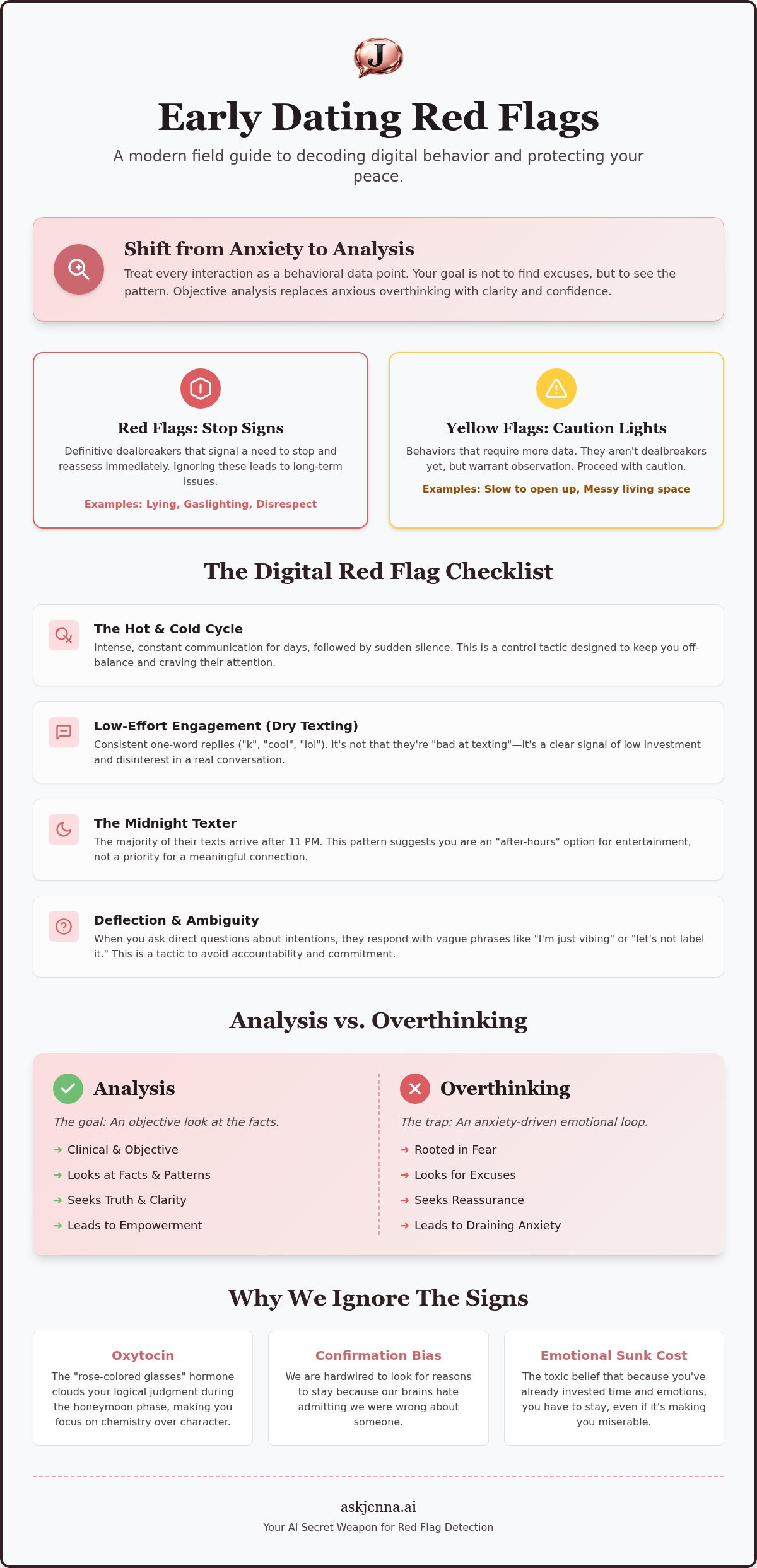
A red flag isn't just a "vibe" you get during a first date. It's a behavioral data point. Think of it as a signal from the future. It warns you about long-term incompatibility before you're too deep to walk away. Analyzing early dating red flags requires a shift in perspective. You aren't being "too much" or "dramatic." You're being observant. You're collecting evidence. Data points aren't just what they say. They are what they do, what they don't do, and how they make you feel. Reliability is a metric. Consistency is a metric. If the numbers don't add up, the relationship won't either.
There is a massive difference between analysis and overthinking. Analysis is clinical and objective. It looks at the facts. Did they cancel three times in a row? That's a pattern. Overthinking is an anxiety loop. It's rooted in fear. It's the "maybe they're just busy" or "what if I'm being too sensitive?" cycle. Objectivity kills anxiety. When you analyze, you look for the truth. When you overthink, you look for excuses. Your gut feeling is your nervous system processing micro-signals your conscious mind hasn't caught yet. It signals a mismatch in emotional safety. Trust it.
You must know your signals. A red flag is a stop sign. It's a definitive dealbreaker like lying, gaslighting, or disrespect. A yellow flag is a caution light. It's a behavior that needs more data, like being slow to open up or having a messy living space. Stop for reds. Proceed with extreme caution for yellows. Don't treat a stop sign like a suggestion.
The Evolution of Red Flags in 2026
The dating landscape has shifted. Traditional flags like "rudeness to waiters" still matter, but modern warning signs are digital-first. Dating apps have normalized low-effort behavior. Ghosting is now a standard exit strategy. You're dealing with "situationships" where a lack of labels is used as a shield against accountability. Digital ambiguity is the new norm. If they use "not wanting to rush things" to avoid basic respect, it's not a preference. It's a tactic. Ambiguity is a choice, and in 2026, it's a loud one.
Why We Ignore the Signs
Oxytocin is a liar. It's the "rose-colored glasses" hormone that clouds your logical judgment during the honeymoon phase. You focus on the chemistry and ignore the character. Then comes confirmation bias. We are hardwired to look for reasons to stay because our brains hate being wrong. We fall victim to various cognitive biases that make us rationalize bad behavior. Emotional sunk cost is the toxic belief that because you've already invested three months of your life, you have to stay for three years of misery. Don't throw good time after bad.
The Digital Red Flag Checklist: Decoding the Inbox
Your inbox is a crime scene. In 2026, the most telling early dating red flags aren't found in what people say, but in how they communicate. Digital interaction provides a trail of behavioral data. You just need to know how to read it. Stop making excuses for the "busy" professional. If they have time to post a story, they have time to reply to a text. It's that simple. Consistency is the only currency that matters in the early stages of dating.
The Hot and Cold cycle is the first red flag to watch for. They text you with intense energy for 48 hours, then vanish for three days. This isn't a busy schedule. It's a control tactic designed to keep you off-balance. When they resurface with a low-effort "hey," they are testing your boundaries. They want to see if you'll still be there without them having to put in the work. Similarly, dry texting is a loud signal of low investment. If their responses are consistently one-word answers like "K" or "Cool," they aren't "bad at texting." They aren't interested in a real connection.
Pay attention to the Midnight Texter. If the majority of their communication happens after 11 PM, you aren't a priority. You are an option. This person avoids daytime vulnerability because it implies a level of integration into their real life. They are keeping you in the "after-hours" box. If you aren't sure where you stand, try decoding their messages to see if their tone suggests genuine interest or just late-night boredom. When you ask direct questions about their intentions and they deflect with "I'm just vibing" or "let's not put a label on it," believe them. They are telling you they have no intention of committing.
Digital Body Language 101
Punctuation carries weight. A sudden shift from casual, no-period texts to aggressive, grammatically perfect sentences signals a drop in temperature. Ellipses are the "..." of doom, often used to create a false sense of mystery or to avoid giving a straight answer. Emoji usage is another key indicator. Overuse can be a way to mask a lack of emotional depth, while a total lack of emojis in 2026 often feels clinical and detached. Watch for breadcrumbing. This is the act of sending just enough "likes" or memes to keep you on the hook without ever committing to a date.
Privacy vs. Secrecy
There is a line between healthy privacy and suspicious secrecy. The Phone Guard is a classic signal. If their phone is always face down or they take it with them to the bathroom every single time, they are protecting more than just their data. Social media shadows are another red flag. If you've been seeing someone for months and you haven't even been "soft-launched" on their stories, they might be hiding you from someone else. Finally, beware of the Ghosting-Resurfacing loop. They disappear for weeks, only to "zombie" back into your life the moment they see you've moved on. Don't let them back in. The pattern is the message.
Beyond the Screen: Behavioral Patterns That Signal Trouble
Reality hits when you leave the group chat and meet in person. Digital decoding is essential, but behavioral patterns in the real world provide the final verdict. These early dating red flags are often disguised as passion or intimacy. They are actually strategic maneuvers designed to gain control. You must separate the performance from the person. Character is revealed in the moments between the highlights. Don't let chemistry blind you to the data points standing right in front of you.
If it feels like a movie script, it is probably a performance. Love bombing is the act of overwhelming you with affection, gifts, and "soulmate" talk within days of meeting. It is a dopamine trap. They want to fast-track the relationship to bypass your natural defense systems. Closely linked to this is future faking. They will talk about a summer trip to Italy on your second date. They aren't planning a vacation. They are trying to secure your loyalty today with a promise they have no intention of keeping. It is a manipulation of your hope.
A total lack of accountability is a non-negotiable stop sign. If every conflict in their life was caused by someone else, you are next in line to be the villain. Watch for boundary testing. It starts small. They might "playfully" ignore a request to stop a certain behavior or show up an hour late without a real apology. These aren't accidents. They are probes. They want to see how much disrespect you will tolerate before you push back. If you don't set the line now, they will keep moving it.
The Ex Factor and Victim Narratives
Listen closely to the "crazy ex" story. If every past partner was unstable, the common denominator is sitting across from you. A victim narrative suggests they lack the self-awareness to own their mistakes. Are they using you as an emotional dumping ground? If you feel more like a therapist than a date, you are being used to process baggage they haven't handled. You aren't a rehab center for broken people. Unresolved baggage will eventually become your burden to carry.
Social and Emotional Intelligence
The service staff test is the ultimate character reveal. If they are charming to you but condescending to the waiter, the charm is a mask. It is only a matter of time before that mask slips in your direction. Watch for the "One-Upper." If you share a win and they immediately pivot to a bigger story about themselves, they lack the empathy to hold space for you. Finally, look for rapid volatility. If they flip from high praise to cold withdrawal because of a minor inconvenience, your emotional safety is at risk. Stability is the foundation of a healthy connection.
How to Analyze Red Flags Without Losing Your Mind
Knowing what a warning sign looks like is only half the battle. The real challenge is processing that information without letting your emotions rewrite the script. Analyzing early dating red flags requires a systematic approach. You need to move from "how do I feel about this?" to "what is the data telling me?" Stop the mental gymnastics. If you have to work this hard to justify their behavior, you already have your answer. Follow this five-step framework to regain your perspective.
- Step 1: Document the behavior objectively. Strip away the "why." Don't say, "he was probably stressed at work." Say, "he cancelled our date thirty minutes before we were supposed to meet." Remove your excuses and look at the raw event.
- Step 2: Look for frequency. An incident is a fluke. A pattern is a personality trait. One slow reply is a busy afternoon. Four consecutive days of "hot and cold" communication is a strategy.
- Step 3: Test the boundary. Give them a firm "no" or set a small limit. If you aren't comfortable with late-night invites, say so. Their reaction to your "no" tells you everything you need to know about their respect for your autonomy.
- Step 4: Use objective tools. Your brain is currently flooded with dopamine and oxytocin. It is a biased observer. Use AI-driven red flag detection to get a clinical breakdown of their messaging patterns. Remove the emotional fog.
- Step 5: Decide your non-negotiables. Write down three things you will not tolerate before your next date. If they hit one, you walk. No second chances. No "maybe they'll change."
The Journaling Method for Pattern Recognition
Memory is selective. When you're lonely, you remember the good morning texts and forget the three days of silence. Track relationship trends over weeks, not just days. Use journaling and pattern recognition tools to spot recurring behavioral loops. If you see the same "disappear and resurface" cycle happening every two weeks, it's not a coincidence. It's a loop. Documentation prevents gaslighting. It's much harder to ignore the truth when it's written in your own handwriting.
Objective vs. Subjective Analysis
Apply the Friend Test. If your best friend told you their date was doing exactly what yours is doing, what would you say? You'd probably tell them to run. We are often more protective of others than we are of ourselves. Separate what they said from what they did. Their words are the marketing. Their actions are the product. Consistency is the only metric that matters. If their "I'm so into you" doesn't match their "I'm too busy to see you," believe the behavior every single time.
Ask Jenna: Your AI Secret Weapon for Red Flag Detection
Stop the guessing game. You don't need a psychic or a biased group chat to tell you if a text is toxic. You need data. Ask Jenna is the objective truth-teller friend who never sleeps. While June 2026 data shows that 65% of millennials are already using AI for relationship advice, most tools are generic. Ask Jenna is different. It provides early dating red flags detection with surgical precision. It analyzes the sentiment behind the screen, stripping away the "maybe they're just busy" excuses to reveal the actual intent. It's time to trade your anxiety for immediate clarity.
Objective analysis is the only way to spot manipulation before you're hooked. Ask Jenna identifies patterns like love bombing, breadcrumbing, and gaslighting in seconds. It doesn't just identify the problem; it provides the solution. Through advanced response generation, you can call out red flags with confidence. You'll get clear, assertive scripts to set boundaries or walk away. This isn't about playing games. It's about maintaining your power in a digital landscape designed to keep you guessing. When the subtext is murky, Ask Jenna makes it crystal clear.
Pattern recognition is the ultimate long-term play for your dating life. We all have "types" that are actually just recurring traps. Ask Jenna automatically tracks these behavioral loops across different conversations. It sees the big picture when you're too close to the situation to notice. If you're consistently attracting people who lack accountability, the AI will highlight that trend. You can finally stop dating the same person in different bodies. Knowledge is your best defense against early dating red flags that lead to dead-end situationships.
How Ask Jenna Decodes Your Chats
Upload a screenshot. It's that simple. Ask Jenna analyzes the digital body language of your conversation instantly. You'll get an immediate breakdown of emotional availability and investment levels. It detects the hidden meanings in dry texts or those frustrating mixed signals that keep you up at night. If a conversation feels off, the AI provides safe and efficient help to navigate the tension. You aren't just getting an opinion. You're getting a clinical read on the relationship's health. Move from confusion to certainty in one click.
Take Control of Your Dating Narrative
Build your profile with confidence and attract quality matches who actually align with your goals. Once you're in the game, utilize journaling that actually works. Ask Jenna’s journaling tools identify your dating traps by analyzing your entries for recurring themes. It helps you recognize when you're settling for less than you deserve. Stop being a passenger in your own dating life. Take the wheel and protect your emotional energy. Protect your peace—let Ask Jenna analyze your red flags today.
Master Your Dating Data
You have the evidence. You know that early dating red flags aren't just inconveniences; they are behavioral data points that predict your future. By shifting from anxious overthinking to clinical analysis, you regain total control of your narrative. You've learned to decode the silence in your inbox and recognize the strategic performance of love bombing. Now, it's time to stop doing the heavy lifting alone. Don't let another mixed signal drain your emotional battery.
Clarity is a choice. You can continue the guessing game, or you can leverage no-nonsense relationship intelligence to see through the noise. Get instant certainty with AI-powered text decoding and identify recurring loops through pattern recognition journaling. These tools replace confusion with confidence. You have the checklist and the intuition; now get the strategic advantage you deserve. Your time is too valuable for ambiguity.
Analyze your red flags with Ask Jenna now and start dating with the truth on your side. Protect your peace and trust the patterns. You're ready to make better decisions.
Frequently Asked Questions
What is the most common red flag in a new relationship?
Inconsistency is the most frequent indicator of long-term trouble. It usually manifests as a "hot and cold" cycle where the person is intensely attentive one day and completely invisible the next. This behavior signals low emotional availability or a tactical use of attention to keep you off-balance. Don't excuse it as a busy schedule. Consistency is the only reliable currency in early dating.
How do I tell the difference between a red flag and a mistake?
Frequency is the metric that separates a one-off mistake from a definitive red flag. A mistake is an isolated incident followed by a genuine apology and an immediate change in behavior. A red flag is a recurring pattern that persists despite your feedback. If you see the same behavior three times, it isn't an accident. It is a personality trait you need to acknowledge.
Can a relationship survive red flags if we talk about them?
Most early dating red flags are character-based stop signs that communication cannot fix. While talking is healthy, you can't negotiate someone into having respect or accountability. If the behavior is rooted in manipulation or a lack of empathy, a conversation is just another opportunity for them to future-fake. You're dating a person, not a renovation project. Believe who they are right now.
Is slow texting always a red flag?
No, but a sudden shift in texting frequency is a major warning sign. Some people are naturally slow communicators, and if they're consistent from day one, it's just a personality trait. The red flag appears when their response time moves from minutes to days without explanation. This shift usually indicates a drop in investment or that they've placed you on the back burner as an option.
How can AI help me analyze relationship red flags?
AI provides the clinical objectivity that your emotions often cloud during the honeymoon phase. Tools like Ask Jenna use sentiment analysis to decode the intent behind messages and identify manipulation patterns with surgical precision. It removes the guesswork from digital ambiguity. By analyzing data points instead of "vibes," you get a clear, unbiased read on whether a connection is healthy or toxic.
What should I do if I find multiple red flags in my relationship?
Walk away immediately and stop looking for reasons to stay. One red flag is a warning; three or more is a confirmed toxic pattern. You're collecting behavioral data that proves long-term incompatibility. Trying to "fix" someone else is a waste of your emotional energy. Exit the situation before you become more entangled. Protect your future self by making the hard choice today.
How do I bring up a red flag to my partner without starting a fight?
State the objective facts using "I" statements and observe their reaction. Say, "I noticed you've been cancelling our plans lately, and it makes me feel like my time isn't being respected." A healthy partner will listen and adjust. A person showing early dating red flags will likely get defensive or gaslight you. Their reaction to your boundary is the final piece of data you need.