 Ask Jenna
What Does 'K' Mean in a Text? The Cold Truth About 1-Letter Replies

A single letter can feel like a punch to the gut. You spent ten minutes crafting the perfect message, only to receive a solitary "K" in return. It's not just a typo. It's a digital temperature check that often reveals a chilling lack of investment. You're likely wondering, what does k mean in a text and why does it feel so dismissive? It's the sound of a conversation hitting a brick wall.
It's exhausting to decode these mixed signals while your anxiety spikes. You've stared at that gray bubble long enough, wondering if you overstepped or if they're just busy. This guide will stop the overthinking once and for all. You'll learn exactly what that one-letter reply says about your current relationship dynamic and the sender's true mood. We are stripping away the digital ambiguity to give you a strategic advantage. We will cover how to respond with total confidence, when to call out the passive-aggression, and how to recognize the red flags that mean it's time to walk away.
Key Takeaways
- Stop guessing and learn why what does k mean in a text is a digital temperature check revealing their true level of investment.
- Navigate the Effort Spectrum. Understand how the subtle slide from "Okay" to "K" marks the exact moment interest starts to fade.
- Protect your dignity. Get proven strategies to respond to low-energy replies without appearing desperate or needy.
- Identify red flags early. Use pattern recognition to distinguish between a busy contact and someone who is emotionally checking out.
- Reclaim your power. Move from digital confusion to total certainty about your relationship dynamics with objective message decoding.
What Does 'K' Mean? More Than Just an Abbreviation
Technically, 'K' is just 'OK.' In the early days of SMS language, it was a practical necessity. Character limits were tight. Keypads were clunky. Saving three keystrokes actually mattered. But this is 2026. We have unlimited data and high-speed predictive text. Today, a single-letter reply is a deliberate choice. It isn't about efficiency. It's about energy. When you ask what does k mean in a text, you aren't looking for a dictionary definition. You're looking for a motive.
A 'K' text is the digital equivalent of a blank stare. It offers no feedback, no emotion, and no path forward. It signals a 'conversation killer' intent. The sender is effectively telling you they have reached their limit for interaction. They are closing the door. If you feel a sudden chill after hitting send, your intuition is likely right. You are being dismissed.
The Literal vs. Social Meaning
The gap between what is said and what is felt is massive. You must look past the character and see the intent. Most people use 'K' as a social shield.
- Literal: "I acknowledge your message." This is the surface-level truth.
- Social: "I am ending this interaction now." This is the emotional reality.
Context is your only compass here. If you just sent a long, vulnerable paragraph and received a 'K' in return, the message isn't 'okay.' The message is 'I don't care enough to engage.' Adding a period makes it even more pointed. A 'K.' isn't just short. It's a full stop on your connection. It's 10x worse because it shows they took the extra effort to be formal about their coldness. It's a deliberate punctuation of their annoyance.
Common Scenarios for the 'K' Reply
Not every 'K' is a death sentence for your relationship. You need to identify the pattern before you react. Start by categorizing the energy behind the letter.
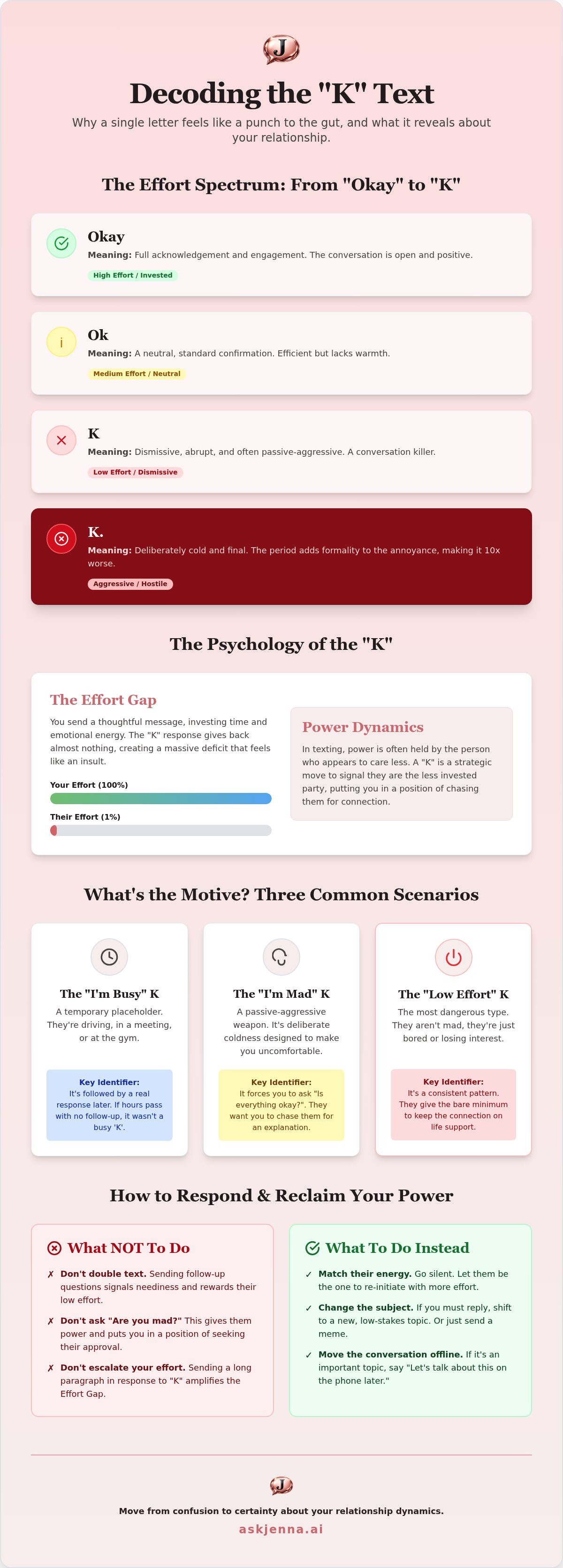
The 'I'm Busy' K: This happens when someone is driving, at the gym, or in a meeting. It's short, but it's usually followed by a real response later. Look for the follow-up. If the energy stays low for hours, it wasn't a busy 'K.' It was a choice.
The 'I'm Mad' K: This is a weapon. It's a deliberate choice to show coldness without using words. It's designed to make you uncomfortable. It forces you to ask if everything is okay. That is exactly what they want. They want you to chase them.
The 'Low Effort' K: This is the most dangerous scenario. It's a sign of fading interest. They aren't mad. They're just bored. They are giving you the bare minimum to keep the connection on life support without actually contributing to it. Recognize this for what it is: a lack of investment.
The Psychology of the Passive-Aggressive 'K'
"K" is a closed posture. Imagine talking to someone who crosses their arms, looks at the floor, and gives a one-word grunt. That is exactly what a single-letter text represents in the digital world. When you're trying to figure out what does k mean in a text, your brain is actually sensing a lack of psychological safety. It's the "Effort Gap." You put in 100% emotional effort; they gave you 1%. That 99% deficit feels like an insult because it is. It's a deliberate withholding of energy designed to keep you at a distance.
Passive-aggression thrives in brevity. By choosing the shortest possible response, the sender uses silence as a weapon. They maintain control by saying as little as possible, forcing you to fill in the blanks with your own insecurities. This isn't just "being brief." It's a strategic move to stay guarded while making you feel overexposed. It triggers the brain's rejection sensitivity, making a simple notification feel like a personal attack. We are social creatures hardwired for belonging. "K" signals the opposite of belonging. It signals exit.
Why It Feels Like a Slap in the Face
Digital communication relies on the law of reciprocity. It's a rhythmic dance. When you send a thoughtful message, you expect a similar level of engagement in return. A single letter breaks that flow and stops emotional intimacy in its tracks. There is a sharp difference between efficiency and dismissiveness. If someone has the time to unlock their phone and open your message, they have the time to type "Okay" or "Sounds good." Choosing not to is a statement of priority. It tells you that your message didn't earn more than a fraction of a second of their time. This disruption of the "social contract" is why you feel a physical sting when that gray bubble appears.
Power Dynamics and the Single Letter
Power in a digital space is almost always held by the person who cares less. Or, at the very least, the person who appears to care less. A digital power dynamic is the balance of perceived effort in a chat. By sending a one-letter reply, the sender signals that they are the less invested party. They are the ones who can walk away without a second thought. It's a subtle form of dominance. They decide when the conversation ends, leaving you to wait, wonder, and eventually, chase. If you're tired of being on the defensive, you can decode their true intent with objective AI analysis. This stops the guessing game and puts the strategic advantage back in your hands. Don't let a single letter dictate your worth.
K vs. OK vs. Okay: Decoding the Effort Spectrum
Every version of acknowledgment has a specific emotional temperature. It isn't just about spelling; it is about the "Effort Spectrum." When you wonder what does k mean in a text, you are really measuring the distance between their effort and yours. A sudden shift from "Okay" to "K" is a clear cooling of interest. It is a withdrawal. You must analyze the sender's baseline before jumping to conclusions. If they are usually wordy and suddenly go silent, the "K" is a signal. If they have always been a one-letter texter, it’s just their personality.
The move from four letters down to one is rarely an accident. It is a digital retreat. In 2026, where predictive text does the heavy lifting, typing "Okay" is effortless. Choosing to delete three of those letters to send a solitary "K" is an intentional act of minimization. It tells you exactly where you sit on their priority list. Stop making excuses for low energy. The spectrum doesn't lie.
The Breakdown of 'OK' Variations
Think of these as levels of digital investment. The more characters they use, the more they care about the perception of the message. The fewer they use, the less they care about your reaction.
- 'Okay': This is the gold standard of polite acknowledgment. It feels complete. It shows the sender is willing to put in the full effort of a four-letter word to maintain a positive vibe. It is respectful.
- 'Ok': This is the casual, neutral middle ground. It is safe for almost any situation. It acknowledges the point without adding any extra emotional weight. It is the baseline for most functional relationships.
- 'K': This is the danger zone. It is the absolute minimum. In most modern contexts, it signals that the sender is either annoyed or has completely checked out of the conversation. Proceed with caution.
When Punctuation Changes the Game
Punctuation acts as digital body language. A single dot can turn a neutral word into an aggressive one. Pay attention to the extras that follow the letter.
'K.' vs 'K': The period is a "full stop." It signals the final, angry word in an argument. It says, "I am done talking about this." A plain 'K' might be lazy, but 'K.' is a choice to be cold. It is a period of finality. It is a period of dismissal.
'Kkk': Don't confuse this with the single-letter variant. This is usually a sign of laughter, excitement, or a simple typo. It carries a much lighter, more chaotic energy. It is rarely a sign of anger. It suggests a relaxed state of mind.
'Ok!': The exclamation point is high energy. It is positive. It is engaging. It shows that the sender is not only acknowledging you but is also happy to be in the interaction. It is the direct opposite of the dismissive 'K'.
Always look at the history of the chat. If you see a consistent move from "Okay" to "Ok" to "K," you are watching interest evaporate in real time. This isn't a coincidence. It is a pattern. Recognize the cooling interest before you get burned by the cold truth.
How to Respond to a 'K' Text Without Looking Desperate
Your response is a statement of self-worth. When someone sends a low-energy reply, your immediate urge is to over-explain or "fix" the awkwardness. Resist this. Double-texting to bridge the gap only signals that you are more invested than they are. It confirms that they hold the power. Instead, use the "Mirroring" technique. If they give you a single letter, give them silence. This protects your emotional investment and forces them to decide if the conversation is worth saving. Understanding what does k mean in a text is only half the battle; knowing how to pivot is where you win.
The "K" is a test of your boundaries. If you chase them, you lose. If you match them, you maintain your status. Silence isn't a failure; it's a strategic pause. It gives the other person room to realize they are being rude. If they value the connection, they will reach out with more substance. If they don't, you have your answer without sacrificing your dignity.
Scenario-Based Responses
You need a strategy for every vibe. Don't guess. Test the waters with these specific templates designed to reveal their true intentions.
- If they are mad: "Hey, you seem short. Is everything good?" This is direct. It calls out the behavior without being accusatory. It puts the burden of explanation on them.
- If they are boring: Match their energy. If they send "K," don't reply. Wait for them to lead with a real topic that actually requires a response.
- If you are done: Leave it on "Read." No response is a powerful response. It signals that you don't have time for low-effort interactions and are moving on to better things.
The Golden Rule: Don't Chase the 'K'
Chasing a "K" sender is a losing game. Asking "Are you okay?" repeatedly doesn't fix the mood. It creates a dynamic where you are the pursuer and they are the prize. You must maintain your digital dignity at all costs. Low effort should never be rewarded with high engagement. You deserve a partner who can type more than one character. You must wait at least 4 hours before following up on a dry text to ensure you aren't acting out of panic.
If you aren't sure which scenario you're dealing with, you can use AI-powered response generation to craft the perfect comeback. Stop overthinking what does k mean in a text and start taking control of the narrative. You have the tools to handle any digital curveball with confidence and precision.
Beyond the 'K': Spotting Communication Patterns with Ask Jenna
An isolated "K" is a bad mood. A week of "K" replies is a red flag. Stop obsessing over what does k mean in a text in isolation and start looking at the trajectory of your connection. One data point tells you nothing. A pattern tells you everything. You must move from emotional reactive mode into strategic analysis. If you are constantly decoding low-energy replies, you aren't in a conversation. You are in a chase. Use data to drive your dating decisions instead of letting anxiety run the show. High-value connections don't leave you guessing.
Communication is a rhythmic exchange. When that rhythm breaks, it is a signal. Ask Jenna's AI decodes the subtext that your brain might be trying to ignore. We provide the objective "truth-teller" perspective you need to see through social games. Whether they are breadcrumbing you with just enough attention to keep you around or simply checking out, the data will reveal the truth. Don't waste another night staring at a gray bubble. Get the clarity you need to stay or walk away.
Is It a One-Off or a Red Flag?
Context is king, but consistency is the kingdom. Ask Jenna's pattern recognition journaling allows you to track communication trends over time. It helps you see the "Effort Gap" clearly. You can detect emotional unavailability before it drains your spirit. Look for these specific shifts in their behavior:
- The Slow Fade: Messages move from "Okay" to "Ok" to "K" over several weeks.
- The Time Gap: Responses take longer while the content gets shorter.
- The Lack of Questions: They acknowledge your points but never ask about your day.
Persistent "dry texting" is rarely a sign of a busy schedule. It is a precursor to ghosting. Research shows that 87% of people check a new text message within 15 minutes of receiving it. If they wait hours only to send a single letter, they are making a statement about your priority level. Our Red Flag Detection highlights these shifts so you can protect your energy and your time.
Get the Clarity You Deserve
You don't have to navigate this digital maze alone. Ask Jenna provides safe and efficient help for the hardest digital interactions. Our AI-powered text message decoding strips away the ambiguity. It gives you the objective truth that friends often sugarcoat. When you receive a dismissive reply, use our response generator to handle the situation with class. You can match their energy with surgical precision or call out the behavior without sounding desperate. Stop the guessing game and reclaim your peace of mind. Analyze your messages now and stop the guessing game. You deserve a connection that requires more than one letter to sustain.
Take Control of Your Digital Narrative
A single letter shouldn't have the power to ruin your day. You now know that "K" is rarely about a busy schedule and almost always about a shift in energy. It is a digital wall designed to end an interaction or signal a lack of investment. Stop losing sleep over what does k mean in a text and start looking at the bigger picture. Your time is too valuable to spend it chasing someone who can't be bothered to type four letters. By mirroring their effort and recognizing the cooling of interest early, you protect your dignity and your peace of mind.
The truth is often hidden in the patterns, not just the individual messages. Leverage AI Relationship Intelligence to see through the noise. Use Pattern Recognition Journaling to track how their investment changes over time. If the "K" replies become a habit, our Red Flag Detection will help you see the reality before you get hurt. You deserve a connection built on mutual effort and clear communication. Decode your texts and spot red flags with Ask Jenna. It is time to replace your digital anxiety with total certainty. You are back in the driver's seat now.
Frequently Asked Questions
Is texting 'K' always rude?
No, but it's almost always a sign of low effort. In high-stakes situations like driving or emergencies, it's a functional shortcut. In a standard conversation, it's a digital wall. If they have the time to open your text, they have time for a full word. Choosing the absolute minimum tells you exactly where you sit on their priority list. Context is the only thing that saves it from being dismissive.
What should I do if my crush sends me a 'K'?
Stop texting immediately and match their energy. Do not double-text to "fix" the vibe or ask if they're mad. Silence is your most powerful tool here. It protects your dignity and forces them to lead the next interaction. If they want to talk to you, they'll find a way to send more than a single character. Let them come to you. Don't chase a ghost.
Does 'K' mean they want to break up?
One "K" is a bad mood, but a pattern of them signals emotional withdrawal. It doesn't always mean a breakup is imminent, but it does mean the connection is cooling. You need to look at the frequency. If they've shifted from wordy paragraphs to one-letter dismissals, they're checking out. Use pattern recognition to track this trend before you make a final move. Don't ignore the silence.
Why do guys send 'K' more than girls?
Men often prioritize functional acknowledgment over emotional maintenance in their messages. They might see "K" as a simple "got it" rather than a social snub. However, this doesn't excuse the lack of effort. Understanding what does k mean in a text from a guy usually reveals a preference for brevity or a total lack of social savvy. Don't over-analyze one text; watch for the long-term trend.
What is the difference between 'K' and 'KK'?
"K" is often cold and dismissive, while "KK" is casual and friendly. The double letter suggests a lighter tone and active acknowledgment without the passive-aggressive weight of a single "K." It's the difference between a grunt and a cheerful nod. If they switch from "KK" to "K," take note. That one-letter reduction is a deliberate withdrawal of warmth. It's a clear signal of cooling interest.
How do I tell someone their 'K' texts are annoying?
Be direct and set a clear boundary. Say, "Hey, I find one-letter replies a bit dismissive. I'd prefer a real response when we're chatting." Don't apologize for having standards. If they value the relationship, they'll adjust. If they get defensive or keep doing it, they're showing you that your needs aren't a priority. Believe their actions. High-value connections require more than the bare minimum effort.
Can AI really decode what a 'K' means in my specific chat?
Yes, because AI uses pattern recognition and sentiment analysis to see what your anxiety might miss. It looks at response times and historical data to determine the sender's true intent. While you're blinded by emotion, AI provides an objective "truth-teller" perspective. It helps you identify what does k mean in a text by comparing it to your unique relationship history. Stop the guessing and use the data.