 Ask Jenna
How to Analyze Conversation for Red Flags: Stop Guessing and Start Decoding

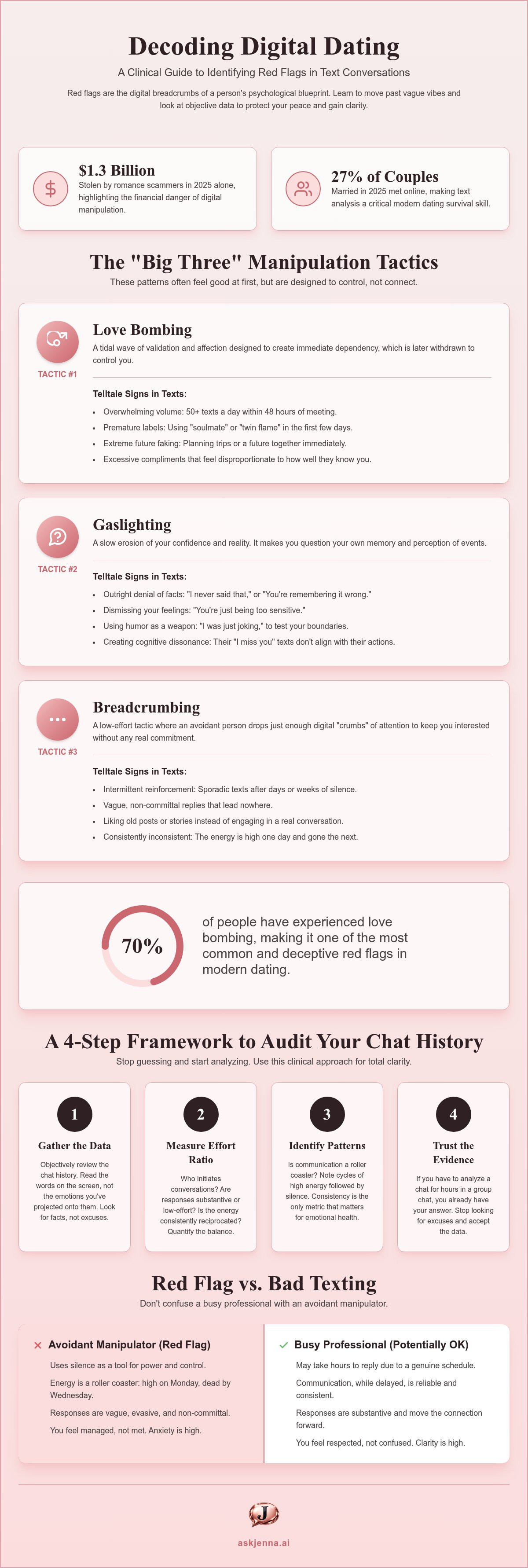
Red flags aren't just words. They are the digital breadcrumbs of a person's psychological blueprint. You've spent hours staring at a pulsing three-dot bubble, wondering if you're overthinking a single sentence. It's exhausting. You're tired of the mixed signals that feel more like a psychological maze than a connection. It's time to stop guessing and learn how to analyze conversation for red flags with surgical precision. You deserve to know exactly who you're talking to before you give them your heart. With romance scammers stealing $1.3 billion in 2025 alone, the stakes have never been higher.
You probably feel like you're losing your mind every time a text feels "off." We agree that the digital dating world is a minefield of ambiguity. This article is your map. You will learn to move past the vague vibe and look at the objective data. You'll discover how to identify manipulation tactics like love bombing, which 70% of people have already experienced. We'll show you how to spot emotional unavailability and breadcrumbing before you get attached. We are providing a framework to identify toxic patterns and the confidence to walk away early. No more anxiety. Just total clarity.
Key Takeaways
- Decode the "why" behind every text. Learn to spot behavioral toxicity hidden in digital messages before you get emotionally attached.
- Use a clinical 4-step framework to analyze conversation for red flags and objectively measure the effort ratio in your chat history.
- Identify the "Big Three" manipulation tactics-Love Bombing, Gaslighting, and Breadcrumbing-with surgical precision.
- Distinguish between blatant harassment and subtle yellow flags like victim complexes to protect your peace and maintain your standards.
- Leverage AI-driven pattern recognition to stop repeating toxic dating cycles and gain instant clarity on a partner's true intent.
Why Digital Red Flags are the Silent Killers of Modern Dating
Digital text is a mask. It strips away the micro-expressions and vocal shifts that naturally warn us of danger. In a world where 27% of couples married in 2025 met online, the ability to decode text is a survival skill. We define red flags as early indicators of future behavioral toxicity. They are the small cracks in the foundation that eventually lead to psychological abuse. When you analyze conversation for red flags, you aren't being paranoid; you're being precise.
Stop falling for the "Overthinking Trap." Your gut usually registers a red flag long before your brain can articulate it. This delay happens because you are looking for excuses, not evidence. Clarity is power. Ambiguity, on the other hand, is the primary tool of the emotionally unavailable. If you have to analyze conversation for red flags for three hours in a group chat, you already have your answer. You are being managed, not met.
The Psychology of the Digital Screen
Asynchronous communication is the ultimate playground for manipulation. It allows a person to curate a perfect persona. They can pause, edit, and calculate responses that mirror your desires exactly. This delay facilitates grooming. In this context, narcissistic supply is the steady stream of attention and ego-validation a manipulator extracts from their matches without any intention of building a real connection. We often project our own healthy intentions onto their toxic texts. We assume they are just "busy" because that's what we would be. We give them the benefit of the doubt they haven't earned.
Red Flags vs. Bad Texting
Don't confuse a busy professional with an avoidant manipulator. A high-value person might take hours to reply, but their responses are substantive and reliable. An avoidant uses silence as a leash to maintain power. Consistency is the only metric that matters for emotional health. If the energy is high on Monday but dead by Wednesday, it is a pattern, not a fluke. You must learn how to text with confidence in dating to set the pace and flush out these behaviors early. If their communication is a roller coaster, get off the ride. It's better to be single and certain than "chosen" and confused.
The "Big Three" Red Flags: Love Bombing, Gaslighting, and Breadcrumbing
Red flags aren't always obvious insults. They often look like extreme flattery or harmless jokes. To effectively analyze conversation for red flags, you have to look for the hook. Manipulation in the digital age is a calculated game. While we previously discussed the "mask" of the screen, these tactics are the actual scripts manipulators follow. You must look past the surface level of the text. You are looking for the intent behind the interaction. If you feel like you are losing your grip on what's real, it's likely because one of these patterns is at play.
Love Bombing: The High That Leads to a Crash
Love bombing is the most deceptive because it feels good. It is a tidal wave of validation designed to create immediate dependency. If you're getting 50 texts a day from someone you met 48 hours ago, that's not "sparks." It's a flood. Pay attention to "soulmate" or "twin flame" labels used in the first few days. They use this language to bypass your natural boundaries. Healthy interest is a slow build. It respects your time and your space. Love bombing is a sprint toward a crash where they eventually withdraw affection to control you.
Gaslighting in Chat: "You’re Just Being Sensitive"
Gaslighting is a slow erosion of your confidence. It starts with small denials of facts. "I never said that," or "You're remembering it wrong." Love-bombing and gaslighting often work in a cycle. When you call out a contradiction, they pivot. Suddenly, you're "crazy" or "too sensitive." The "I was just joking" defense is a tactical tool. It lets them see how much disrespect you will tolerate before you push back. Cognitive dissonance in text interactions is the mental friction you feel when their "I miss you" texts don't align with their four-day disappearances. If you're stuck in a loop of confusion, you can decode these patterns with Ask Jenna for instant clarity.
Beyond these two, you must watch for breadcrumbing and future faking. Breadcrumbing is a tactic for the avoidant. They drop just enough digital crumbs to keep you from moving on. It’s a "thinking of you" text with zero follow-up. Future faking is even more sinister. They build a fantasy of a shared future-trips, weddings, or meetings-to keep you invested in a present that offers nothing. When you analyze conversation for red flags, remember that talk is cheap. Consistency is the only currency that matters. If their promises don't have a calendar date attached, they aren't real.
Subtle vs. Blatant: Decoding the "Yellow Flags" You’re Ignoring
Blatant flags are loud. They are the digital equivalent of a siren. If a match makes explicit demands, shows aggressive jealousy, or engages in harassment, the conversation is over. Block them immediately. You don't need to analyze conversation for red flags when someone is shouting their toxicity at you. These behaviors are non-negotiable deal-breakers that signal a dangerous lack of respect and self-control. There is no "context" that makes aggressive jealousy acceptable in the first week of chatting.
The real danger lies in the subtle signals. These are the "yellow flags"-the communication gaps that feel slightly off but aren't immediate deal-breakers. Inconsistent "online" status while ignoring your messages and chronic dry texting are classic examples. These behaviors signal low investment or emotional avoidance. Research into modern dating suggests that a significant majority of red flags are felt intuitively before they are confirmed logically. Trust your "vibe check." If the energy feels heavy or confusing, it usually is. While 70% of people report being love bombed, many more ignore the subtle discomfort that precedes the crash.
The Victim Complex: A Major Subtle Flag
Watch how they talk about their past. If every ex-partner was "crazy" and every boss was "unfair," you are looking at a victim complex. This is a massive subtle flag. The "everyone is against me" narrative in early chat is a warning in disguise. It signals a complete lack of accountability. They are never the problem. Eventually, that narrative will shift to include you. You will become the next "crazy" person in their story. A person who cannot own their mistakes is a person who cannot build a healthy relationship.
When to Give a Second Chance
A mistake is a single event. A pattern is a choice. If they miss a text because of a genuine work emergency, that's a mistake. If they disappear every Friday night and reappear on Monday with an excuse, that's a pattern. You can use a relationship pattern recognition tool to separate one-off errors from toxic habits. This tool helps you see the objective data behind the digital noise.
Test a yellow flag by setting a clear boundary. Tell them you prefer a phone call over endless texting or that you value consistency. A healthy person will adjust or explain their limitations with respect. A manipulator will get defensive, mock your needs, or double down on their behavior. Their reaction to your boundary is the ultimate diagnostic. It tells you if the gap is fixable or if it's time to walk away. You should analyze conversation for red flags by observing how they handle your "no." Don't waste months waiting for a yellow flag to turn green. It rarely happens.
How to Audit Your Chat History: A 4-Step Framework
Stop staring at the last message. You need a bird's-eye view. Auditing your history is the only way to see the truth. Most people fail to analyze conversation for red flags because they focus on the "now" instead of the "always." Clarity comes from the patterns, not the isolated moments. Use this framework to strip away the emotion and look at the data. It is time to be your own detective.
Evaluating the Effort Ratio
Screenshot your chat and scroll through the last two weeks. Look at the "blue to grey" ratio. Who is doing the heavy lifting? If you are sending paragraphs and they are replying with single emojis, you have an effort imbalance. Count the question marks. If you are the only one asking about their life, they are using you for validation. Dry texting is rarely about being "busy." It is a sign of low interest or, worse, low empathy. High-value connections require mutual investment. If the effort is one-sided, the respect is too.
Identify the Pivot Points. These are the specific moments where the energy shifted. Did they go from "love bombing" frequency to "breadcrumbing" silence after you met in person? Or perhaps the shift happened after you shared a personal detail. These pivots reveal their true intentions. They show you exactly when they stopped trying or when they started pulling back. Don't make excuses for the change. Accept it as a data point.
Identifying Boundary Pushers
Look for the "U up?" texts. Contrast them with actual daytime planning. A manipulator operates on their own schedule and expects you to follow. Review how they handle it when you say "no" to a request. Do they respect your space, or do they use guilt to change your mind? A "no" is the ultimate diagnostic tool for any relationship. Use this early dating red flags checklist to see how their behavior stacks up against known toxic patterns. If they push back on a small boundary now, they will trample a large one later.
Finally, use AI to decode the emotional subtext you might be missing. You are too close to the situation to be objective. Your brain wants to see the best in them, but the data doesn't lie. A tool can analyze conversation for red flags by scanning for subtle manipulation and avoidant language that your heart wants to ignore. It provides the "street-smart" insight you need to stay protected. You can audit your chat for toxic patterns now to get the clarity you deserve. Stop guessing and start knowing.
Ask Jenna: Your AI Truth-Teller for Relationship Intelligence
You have the framework. You know the "Big Three." Now, you need the execution. Ask Jenna is your digital street-smart confidante. It doesn't just scan words; it decodes the "why" behind the text. While manual auditing is a great start, humans are often biased by hope. AI is not. It uses behavioral psychology models to strip away the "maybe" and give you the "is." When you analyze conversation for red flags with this level of precision, you stop being a victim of ambiguity and start being a strategist of your own heart.
The real power lies in pattern recognition. Most people date the same red flag in different clothes for years. Ask Jenna breaks that cycle. By tracking your interactions over time, the platform identifies recurring toxic dynamics that you might miss in the heat of a new match. It is about long-term emotional health, not just a single text. Stop guessing if they are "the one" and start knowing if they are even worth your Tuesday night. You deserve a connection that adds value to your life, not a puzzle that keeps you awake at 2 AM.
- Response Generation: Don't just spot a flag; test it. Use AI-generated, boundary-setting replies to see how they react in real-time. Their response to your "no" tells you everything you need to know.
- Journaling and Pattern Recognition: Track your emotional state from the first "Hey" to the first date. Identify where your anxiety spikes and see if the same red flags appear across different matches.
- Text Message Decoding: Get instant clarity on mixed messages, dry texting, and avoidant language patterns.
Beyond Red Flag Detection
This is more than a warning system. It is a complete toolkit for a fresh start. We provide style advice and profile building features to ensure you are attracting high-value connections from the jump. You can even use the "dress the part" insights to show up with maximum confidence. Think of it as having a protective friend who has read every psychology textbook and every toxic chat history in existence. This objective perspective is your greatest strategic advantage. It replaces confusion with certainty and empowers you to walk away from anything that doesn't serve you.
Take Control of Your Dating Narrative
Stop overthinking. The pulsing three-dot bubble shouldn't control your heart rate. You now have the tools to see through social games and digital masks. Whether you are dealing with a potential love bomber or an avoidant breadcrumber, you have the upper hand. Clarity over confusion. Every single time. It is time to act with certainty and protect your peace. You can analyze your conversation for red flags with Ask Jenna now and finally start decoding the truth.
Stop Guessing and Start Dating with Certainty
You don't have to live in a state of constant second-guessing. Digital dating is a game of subtext, but you now have the rules. You've learned how to spot the "Big Three" and how to audit your chat history for effort imbalances. Most importantly, you know that your gut feeling is a data point that deserves a logical investigation. It's time to replace anxiety with precision.
When you analyze conversation for red flags, you aren't being difficult; you're being discerning. You are protecting your future self from predictable patterns of toxicity. Don't let another week pass in a fog of mixed messages. You can use AI-driven pattern recognition and instant text decoding to get the answers you need right now. There's no human coaching involved. This is pure objective data to help you see the truth.
Take the power back. Analyze your chat for red flags with Ask Jenna and stop dating in the dark. You are worthy of a connection that is clear, consistent, and safe. Your time is too valuable for games. Go find something real.
Frequently Asked Questions
How can AI accurately detect red flags in a text conversation?
AI uses behavioral psychology models to identify linguistic patterns associated with manipulation. It looks for shifts in narrative, pressure tactics, and emotional distancing. Unlike humans, AI doesn't get distracted by "butterflies" or hope. It stays objective. This allows you to analyze conversation for red flags based on historical data points rather than fleeting feelings. It decodes the subtext you might miss when you're emotionally invested.
What are the most common red flags to look for on a dating app?
Look for immediate requests for personal details or a push to move off-app within minutes. Intense affection early on is another warning. These are the precursors to love bombing. Watch for defensive reactions when you ask simple questions. If they act like a victim in every story they tell, they lack accountability. These signals are the foundation of future behavioral toxicity and should never be ignored.
Is dry texting always a red flag for emotional unavailability?
Dry texting is a symptom of low investment, not always a character flaw. It might mean they are genuinely busy once or twice. However, if it becomes the standard, it's a red flag for emotional unavailability. It shows they aren't willing to match your energy. Consistency is the only metric that matters in digital dating. If the effort ratio is consistently off, walk away before you get attached.
Can I use a red flag checker app for someone I just met?
Yes, you should use one early to prevent emotional attachment. Using a tool to analyze conversation for red flags helps you set boundaries from day one. It identifies subtle "yellow flags" like inconsistent online status before you waste weeks on a dead-end match. Early detection is your best defense against digital manipulation. It gives you the confidence to walk away before the stakes get too high.
What should I do if my chat analysis shows a high risk level?
Take immediate action to protect your peace. Stop sharing personal information and disengage from the conversation. High risk levels often correlate with tactics like gaslighting or grooming. Don't try to "fix" the person or explain why you are leaving. A high-risk score is a definitive signal to block and move on. Trust the objective data provided by the analysis. Your safety is more important than being polite.
How do I tell the difference between a red flag and a misunderstanding?
A misunderstanding is a one-time event that is easily resolved with clear communication. A red flag is a recurring pattern. If you set a boundary and they respect it, it was a mistake. If they mock you or get defensive, it's a flag. Watch their reaction to your "no." That is the ultimate diagnostic tool for any connection. Misunderstandings lead to growth; red flags lead to emotional exhaustion.
Is it "creepy" to use AI to analyze my dating messages?
No, it's smart and protective. In an era where romance scammers stole $1.3 billion in 2025, being savvy is a necessity. Think of it as a digital street-smart confidante. It provides a strategic advantage in complex social situations. Protecting your mental health and safety isn't creepy; it is essential relationship intelligence. You are using technology to level the playing field against manipulators and social games.